Resilience in a Rucksack:
A strategy for mitigating the effect of trauma, and cultivating resilience with the Social Learning Communities and Classrooms in the Ukraine
Research has shown that traumatic, violent experiences have profoundly adverse effects on child development and subsequent learning abilities (Williams 2017). The effects of trauma on children are significant in many areas of development, including emotional, psychological, cognitive, social and physical. (Bartlett et al 2018).
Over the past ten years, research on school-aged children indicates that children are impacted on a multiplicity of levels. Emotional/psychological effects may include: increased anxiety, dis-regulation, PTSD, depression, low self-esteem and inability to contemplate the future. Cognitive effects impact concentration and memory recall, difficulty with critical thinking and struggles with problem solving abilities. Physical impacts of trauma are revealed in a multitude of somatic symptoms, such as headaches, and sleep disturbances. Social effects may reveal social withdrawal, attachment issues, or aggressive behavior. Thus the results of trauma have a direct impact on academic performance and cognitive abilities. (MSEA, The Trauma Toolkit, 2017). In the Ukraine, the effects of trauma not only impacts school children, it is impacting educators as well.
However, through education and professional development, educators in the Ukraine can learn to implement a variety of instructional strategies to mitigate the impact of trauma for themselves, and for the children they teach. Evidence-based research has shown effectiveness of trauma-sensitive engagement techniques and teaching strategies which allow for their learning communities to act as buffers to outside trauma; and to help learners engage in whole child learning systems which utilize protocols and systems designed to foster resilience and positive engagement. (Blaustein and Kinnіburgh 2010).
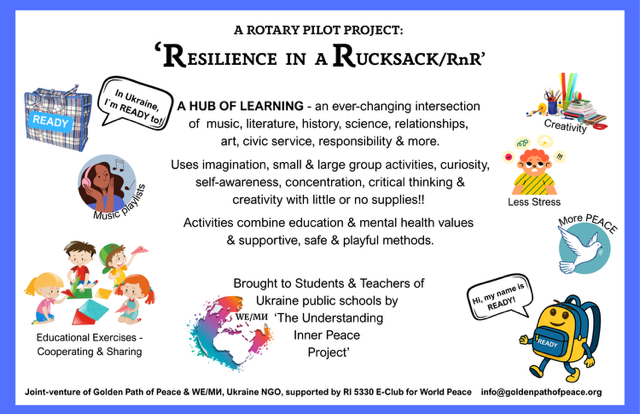
The Understanding Peace Project’s “Resilience in a Rucksack,” Project is designed to support teachers and caregivers to create a safe, positive learning environment, allowing easy-to-access teaching ideas and strategies based in trauma-sensitive learning protocols which promote: building relationships and trust; Social-Emotional Learning; flexible teaching approaches incorporating choice and autonomy; collaborative games for learning; peer support; and art-enhanced creative and engaging activities that allow students to express themselves and find a positive pathway to a caring community, which fosters growth and support. (Halloran 2016).
For more information about Resilience in a Rucksack, contact Barbara Leger
barbaragoldenpathofpeace@sonic.net
Rotary E-club for World Peace, D5330
US/Ukraine Inter Country Committee