Rotarian John (pseudonym) shared his Rotary club’s experience that happened about three years ago. His club visited a community of individuals with physical handicaps. The club members watched in sympathy as these individuals struggled to move and get their work done. As a result, the club decided to purchase wheelchairs to enable them to move much better. It was an exciting opportunity, which the club embarked on with much enthusiasm and a sense of purpose.
The money was raised, the wheelchairs purchased, and joyfully delivered to the community. A job well-done; a box checked!
A few months later, some club members went back to visit the wheelchair beneficiaries. To their disappointment, the beneficiaries had sold the wheelchairs and were back to their original way of movement. Their leader revealed to the club members that they actually benefited more from being seen as handicapped, crawling, than from being in wheelchairs. So, they opted to sell the wheelchairs and use their infirmities to get money from people!
This was an excellent Rotary learning experience. The Rotary Club realized they had not obtained the community's permission to acquire the wheelchairs. They expected the chairs to provide them with much-needed relief. This event exemplifies one of the reasons Rotary Cadres collaborate with clubs, ideally before a project is completed. If Rotary had consulted a Cadre, that person would have advised the club members to organize meetings with the community to ascertain their true needs. Clearly, the community required financial assistance; perhaps a project to boost their economic empowerment would have developed from the conversations.
Rotarian John (pseudonym) shared his Rotary club’s experience that happened about three years ago. His club visited a community of individuals with physical handicaps. The club members watched in sympathy as these individuals struggled to move and get their work done. As a result, the club decided to purchase wheelchairs to enable them to move much better. It was an exciting opportunity, which the club embarked on with much enthusiasm and a sense of purpose.
The money was raised, the wheelchairs purchased, and joyfully delivered to the community. A job well-done; a box checked!
A few months later, some club members went back to visit the wheelchair beneficiaries. To their disappointment, the beneficiaries had sold the wheelchairs and were back to their original way of movement. Their leader revealed to the club members that they actually benefited more from being seen as handicapped, crawling, than from being in wheelchairs. So, they opted to sell the wheelchairs and use their infirmities to get money from people!
This was an excellent Rotary learning experience. The Rotary Club realized they had not obtained the community's permission to acquire the wheelchairs. They expected the chairs to provide them with much-needed relief. This event exemplifies one of the reasons Rotary Cadres collaborate with clubs, ideally before a project is completed. If Rotary had consulted a Cadre, that person would have advised the club members to organize meetings with the community to ascertain their true needs. Clearly, the community required financial assistance; perhaps a project to boost their economic empowerment would have developed from the conversations.
Rotary has expanded and changed over time. By July 1, 1995, the clubs were approximately 28,149. Fast forward to 2026, and there are approximately 45,000 clubs worldwide. The number of clubs competing for TRF has increased tremendously, as have the stakes for qualifying for The Rotary Foundation (TRF) funding. Many clubs' finances fall through the cracks due to oversights, errors, omissions, and other issues that may have been addressed during the initial planning stage.
Clubs must consequently put extra effort into submitting project proposals that fit the TRF funding criteria. Inevitably, the support required by clubs (new and old) has doubled, and TRF needs assistance to support clubs with project applications and implementation. Rotary is nothing without projects, so clubs are encouraged to submit project concept papers to attract funding from TRF. However, clubs have to meet certain criteria to receive TRF funding.
For this reason, TRF assembled a group of Rotarians to give free consultation services during the process of applying, implementing, monitoring, and reporting on Rotary projects. This group of dedicated volunteers is known as the Rotary Foundation Cadre of Technical Advisers, or simply Cadres.
More than 500 Cadres have been established since 1995, covering seven geographic regions, over 75 nations, and using approximately 80 languages.
As members of the district resource network, the Cadres receive specialized training and make use of a variety of tools to assist clubs with grant applications, planning, and execution. Using their expertise in the seven areas of focus and financial auditing, these individuals assist clubs with applying, implementing, and reporting on project grants. To provide guidance on project feasibility, sustainability, and the latest grant requirements, Cadres collaborate with clubs, districts, zones, regions, and Rotary Action Groups. It is incumbent upon District Governors, District Officers, Club Presidents and their Directors / Chairs to seek out the services of the Cadres.
Specifically, Cadres:
Assist clubs in designing community assessments
At the inception stage, Cadres guide club project teams to ensure that proper community assessment is done. It is critical for Rotary to understand the community’s history, culture, local conditions and practices, weaknesses, and strengths to identify challenges and collaborate with the community to address their needs, rather than imposing what Rotary believes the community requires, as John’s experience demonstrates. Assessments enable communities to participate in decision-making, increasing their involvement in the project. Cadres may attend initial meetings or review the grant application documents to assess how assessments were conducted, who was involved in the process, and the project's feasibility.
Advise clubs during the project planning to determine feasibility
A project may not always be practicable in accordance with TRF regulations and individual areas of focus guidelines. Such ventures, no matter how worthwhile, would not be funded. Some initiatives may be difficult to implement, manage, or even assess for impact. Cadres help clubs address bottlenecks in order to secure finance clearances.
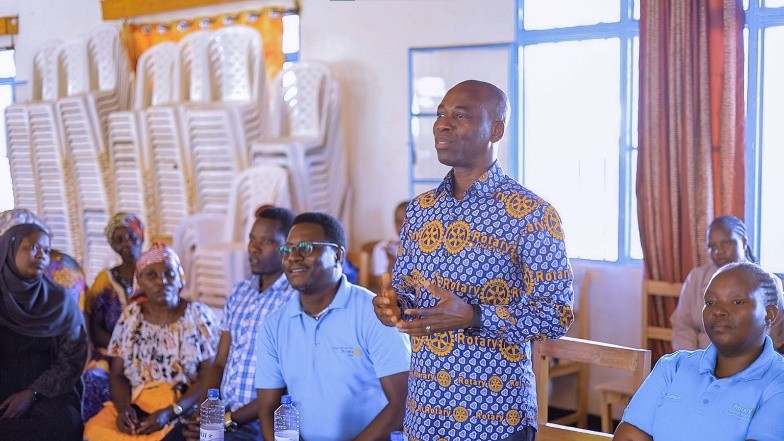
At a stakeholders’ meeting with Cadre Emmanuel Quarshie during an evaluation of a Global Grant award. Musha, Rwanda. |
Assist clubs during implementation stages to ensure they don’t veer from the guidelines
It is relatively common for clubs to plan for projects without following TRF guidelines. The Cadre assists clubs to navigate ‘My Rotary’ to become familiar with the various online resources, and to take advantage of the online training site, particularly for planning, applying for, and implementing global grants.
Align projects with the right areas of focus
TRF awards funding for projects in Rotary’s seven areas of focus. Cadres assist clubs to align their projects with the most relevant areas of focus.
Plan for sustainability
It is one thing implementing a project, and another to ensure continuity when the Rotary funding ends. A great project is one that would outlive the initial years of implementation, and produces measurable positive impact within the community. Rotary is now very keen on committing communities to take on the responsibility of sustaining the project when the funding period ends. Planning for sustainability is required at the inception of the project. Cadres assist clubs to identify areas that would support/prevent sustainability so that they are addressed from the start.
Plan for project monitoring and evaluation
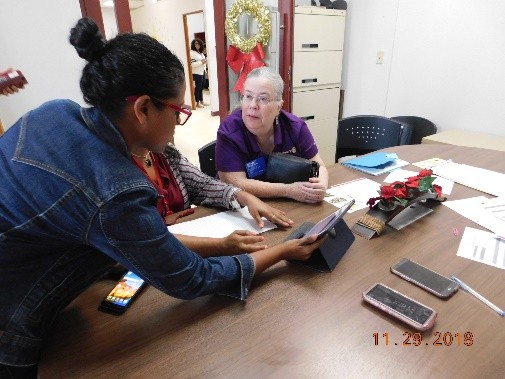
November 2018, Puerto Rico — Around the table, a Cadre review comes to life as Cadre member and local leaders study materials, discuss progress, and assess an in-progress Rotary global grant supporting phonetics in Head Start centers throughout Puerto Rico. |
Clubs must include a project monitoring plan in their project proposals. To facilitate follow-up throughout implementation, the Cadre helps clubs develop key performance indicators and ensures they are emphasized during the planning phase.
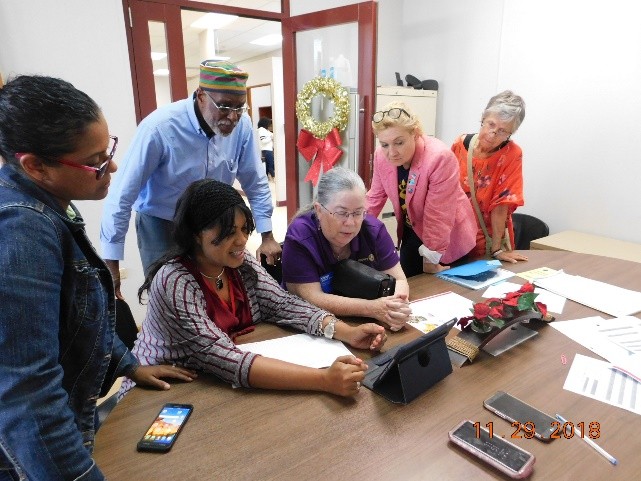
November 2018, Puerto Rico — One of the most important parts of Cadre service is asking thoughtful questions, listening carefully, and reviewing progress on the ground. Here, Cadre member, Sherri Muniz, and project partners examine the in-progress global grant bringing phonetics resources to Head Start centers throughout Puerto Rico |
Provide for financial best practices
Cadres help clubs set up the necessary financial processes from the start, such as opening project accounts, assigning the appropriate signatories, financing tracking systems, adhering to reporting rules, document tracking, filing, and so on. If this is done and followed through, it will be much easier to report and close out the project with minimal hiccups.
Conduct site visits
TRF, districts, or clubs may request that Cadres conduct site visits for monitoring and assessment. Meetings with clubs, communities, and other stakeholders are necessary to better understand the project and provide relevant direction. Cadres submit objective written reports that update TRF on the project's status if TRF requested the site visit. Site visits may occur at the beginning, middle, or end of the project. The primary purpose is to ensure that execution followed the TRF principles of financial responsibility, sustainability, and robust community engagement, regardless of project level at the time of the visit.
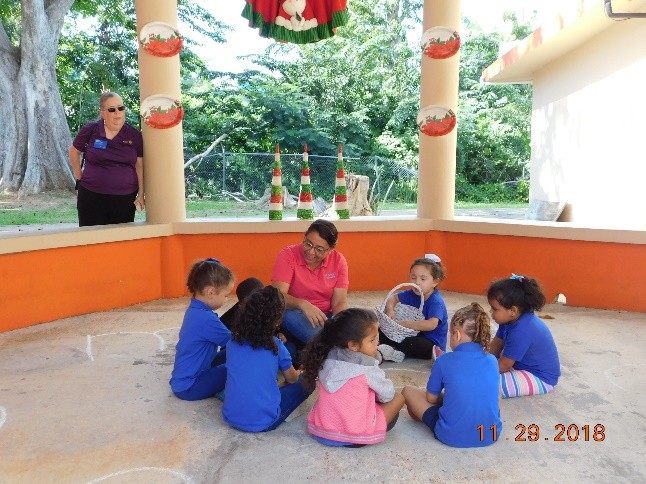
November 2018, Puerto Rico — Cadre members do more than review paperwork; they visit project sites to see real impact in action. On this visit, Cadre member Sherri Muniz observed a global grant bringing phonetics support to children in Head Start centers across Puerto Rico, where early language and reading development was already taking root. |
Training
Cadres support districts and clubs in training project officers from formulation through the end of the project. Cadres must complete the obligatory training through My Rotary to ensure they are disseminating the same material. They are sometimes invited to tour sites across different geographic areas to assess community engagement, review projects to identify areas for improvement, and talk with Rotarians about how to continue assisting communities and other stakeholders.
Cadres are a valuable resource for districts and clubs. They assist clubs by asking all of the questions that the foundation would have asked, saving them time and resources. Cadres, on the other hand, are underutilized because their existence is not widely known.
How to contact the Cadres
To connect to your regional or area of focus Cadre, club, or district officers can send an email to: cadre@rotary.org and request assistance.
For more information about Rotary Foundation Cadres and how to become a Cadre, visit this page via My Rotary.