My heart is imbued with gratitude and hope in sharing the insights that we all gathered from the two-part Webinar series presented by Dr. Rita Aggarwal, the Chair of Rotary Action Group for Mental Health Initiatives, hosted by the Basic Education and Literacy Rotary Action Group. The first webinar was entitled, “Social Emotional Learning: The Foundation for Life Long Success” where we had the honor of being joined by Past R.I. President Gordon McInally (2023-24) whose affirmation that learning outcomes are optimum when we ensure students’ well being and safety, set the tone for both the webinars. Mr. McInally pointed out that education and well being are “essential partners” for “creating lasting impact” in learning outcomes for early and advanced stage learners. Mr. McInally called upon BELRAG and RAGMHI to continue working on their “shared mission” in this direction.
Rotary clubs worldwide can play a powerful role in bringing All District Reads’ Home-Based Family Literacy Program to local school systems and communities.
In Lighting Literacy Fires, by Gary Anderson and John Micklos, we describe the impact of a community-wide One Book program in which families read the same children’s novel aloud at home, chapter by chapter, and stay on the same page. When everyone is reading the same book at the same pace, children, parents, teachers, grandparents, and community members have something meaningful to talk about every day—the book they are reading together.
A Rotary club can help make this happen by bringing the school system and community together around reading. The goal is simple: get families reading aloud together at home and create a community that talks about books.
Dr. Nevine Abdelkhalek is a distinguished leader in education for development, human resources, and sustainable development. Currently serving as the Dean of the School of Continuing Education at Nile University, she holds Charter Manager status with the Chartered Management Institute (UK) and brings over 35 years of professional expertise bridging academia and corporate sectors.
Dr. Abdelkhalek serves on the Board of Directors of both TeaComputers and AfricaConsults. She served on the board of directors of the Egyptian Businessmen Association (EBA)—she currently chairs the Sustainability Committee—She previously spent over a decade as Vice President of ECG Engineering Consultants Group.
A committed pioneer in workforce readiness, she spearheaded the foundation of the Professional Academy for Teachers and launched impactful, sustainable initiatives like "University to Work." Her extensive philanthropic work spans high-level leadership roles in Rotary International, UNICEF collaborations, and serves as the Founding General Secretary of Athar Mustadam NGO, and Treasurer of Hope Village for street children NGO. An international speaker and facilitator, she has chaired numerous global summits on sustainable construction, climate, and vocational training, and currently serves on the Council of Arab Economic Unity's Consultancy Committee for Green Economy.
Koli Banik was a Senior Education Advisor at USAID's Bureau for Africa where she provided technical support to a number of countries in the region. She previously worked at the Global Partnership for Education as an Education Specialist. Her areas of expertise are in girls’ education, gender equity, inclusive education, early childhood development, as well as knowledge management. Before joining the Secretariat, Koli worked for the Population Council, World Bank, American Friends Service Committee, and local NGOs in India. She has extensive field experience working with rural communities in India and Vietnam on gender, reproductive health, and HIV/AIDS. She has a Ph.D. in International Education from the University of Maryland, and a Masters in Social Work from the University of Pennsylvania.
Beatrice Nguo is a seasoned Program Management and Implementation Specialist with over 20 years of experience leading and delivering impactful projects across education, health, and women’s empowerment sectors.
She brings deep expertise in managing multi-sectoral programs, complemented by significant global exposure working with diverse, geographically dispersed teams across multiple time zones.
Beatrice holds a Master of Arts in Sociology (Community Development) and a Master of Science in Human Resources Management.
In addition to her professional accomplishments, Beatrice is a passionate Rotarian and currently serves as the Immediate Past President (IPP) of the Rotary Club of Nairobi Karengata. During her presidency in the Rotary Year 2024–2025, her strong commitment to education shaped the club’s strategic focus and impact.
Under her leadership, the club of 45 Rotarians delivered several high-impact community projects, including: ✅ Construction of 2 new classrooms at a rural primary school, expanding learning opportunities for children ✅ Establishment of a fully equipped Science Laboratory and Library at a high school in Kibera, Kenya’s largest informal settlement ✅ Distribution of over 4,500 school textbooks to six underserved schools ✅ Provision of 200+ mobility devices (White Canes) to support visually impaired individuals in Machakos, Makueni, and Kitui counties ✅ Strengthening partnerships with private sector firms and international Rotary Clubs, significantly expanding the club's reach and resources
These initiatives have led to tangible results: improved academic performance, increased student enrollment, and a notable shift in students’ attitudes toward education.
Beatrice continues to champion transformative community initiatives and is driven by a personal mission to create sustainable change through purpose-driven leadership and collaboration.
The following members have been approved by the Board of Directors and will be presented to the BELRAG membership for approval to join the BELRAG Board of Directors for a maximum of two three-year terms beginning 1 July 2026:
Nevine Abdelkhalek, Rotary Club of El Tahrir, Egypt
Dr. Nevine Abdelkhalek holds a chartered manager status with the Chartered Management Institute in the UK. As well as a PhD in Human Resources and has a vast experience in the field of Education for Development and Continuing Educationas she started her career in Education through her postgraduate studies in Boston University and teaching in the Edward Devotion School in Brookline, Boston. She worked for over 25 years on development programs funded by the Canadian Fund, USAID, and the EU, which gave her firsthand experience of the actual needs of deprived communities in Egypt. Dr. Abdelkhalek was also the Team Leader that put together the foundation and the presidential decree of the Professional Academy for Teachers in 2008.
Dr. Abdelkhalek has held various positions in her career and is currently the Dean of the School of Continuing Education at Nile University. She served as Vice President of ECG Engineering Consultants Group in Egypt from 2008 to 2022. Member of the Board of Directors of Tea Computers, 2022 to date, and member of the Board of Directors of the Egyptian Businessmen Association(EBA), 2022 to date.Among her achievements the design and development of the Professional Academy for Teachers and the initiation of two main sustainable projects; One in Upper Egypt in the field of Illiteracy “Eliminating the Sources of Illiteracy” and also University to Work (UTW) and School to Work (STW) Initiatives. She has also recently supported the launch of the UNICEF and Rotary District 2451 - Egypt - "Water for Life" Project, which has been implemented in Upper Egypt since 2013. Dr. Abdelkhalek was the organizing committee chair of the 1st Water Summit with the Rotary & UNICEF, under the Auspices of the Prime Minister, H. E. Eng. Ibrahim Mahlab, in June 2014, entitled "Water is Life”. Besides this, she was the organizing chair of the Egypt Tour of the greatest Meal to End Polio and End Polio Flame during the World Tour, and lit EndPolioNow on the Temple of Luxor. Among her achievements also the organization of the round table of Investment in Upper Egypt in Summer of 2015 focusing on Assiut and Sohag with the Egyptian Businessmen Association (EBA) as well as “Made in Egypt” Forum & Exhibition for Sohag Ethnic productswithRotary.
Dr. Abdelkhalek has always been known as the philanthropist among her family, friends, and colleagues from a very young age. She currently serves on the Consultancy Committee for the Green Economy of the Council of Arab Economic Unity (CAEU). She was selected twice as the Chair of the American University School of Continuing Education Advisory Board from 2009 to 2012 and from 2015 to 2018. At the same time, she has served as Treasurer of Hope Village for street children from 2008 to date. The chair of the Sustainability Committee of the Egyptian Businessmen Association (EBA) in Cairo for many years and still serving, and the chair of the Board of Trustees of The Egyptian European Organization for Training & Development (EEOTD)(2008–2016). Dr. AbdelKhalekhas served on the Board of Directors of BPW Emirates-Egypt as the club's General Secretary. In her capacity as EBASustainability committee chair, she organized the First Seminar on "Accessibility and its role in employment opportunities for citizens with disability" and the Economic Forum in Upper Egypt, entitled "Investment in Upper Egypt: Opportunities and Challenges." Besides this, Dr. Abdelkhalek supported the strategic plan and the organizational development of the Ministry of Urban Renewal &Informal Settlements in 2014–2015. She is also the charter chair of the Artificial Intelligence Rotary Fellowship (AIRF) (2024–2018) and the Founding General Secretary of Athar Mustadam NGO (2025todate)
Kakali "Koli" Banik, Rotary Club of Washington Global, USA
An accomplished international development executive, Koli brings 18 years of global education expertise spanning Sub-Saharan Africa and Asia, with a specialized focus on systems strengthening, foundational literacy, and policy reform. As a Bureau-level technical expert, she has provided strategic oversight for the design and lifecycle management of complex USAID and Global Partnership for Education (GPE) portfolios valued at up to $100 million. Koli's operational acumen encompasses the entire project lifecycle, from executing rapid, high-yield project startups and staff recruitment to engineering sustainable, costed exit strategies in direct coordination with local authorities. Through targeted institutional capacity-building initiatives, such as the Transforming Teacher Education initiative in Zambia, she has successfully equipped Ministries of Education to design data-driven pre-primary programming, scale regional curriculum interventions, and formulate costed national sector plans.
Paralleling her operational leadership is a distinguished 10-year track record in Early Childhood Development (ECD) research and multi-sectoral liaison specialization. A published researcher and a founding advocate for the USAID/LEGO Foundation partnership, Koli is a recognized expert in integrating Learning Through Play (LtP) pedagogy, gender equity, and Social and Emotional Learning (SEL) into national teacher professional development frameworks. Her ability to foster cross-sectoral alignment is demonstrated by over 15 years of experience coordinating holistic child-development initiatives across Ministries of Education, Finance, Health, and Social Welfare. Furthermore, she has advanced global sector knowledge by spearheading the Global Community of Practice for Pre-Primary and leading the "Together for Early Childhood Evidence" (T4ECE) program, facilitating critical peer-to-peer data exchange among international researchers, practitioners, and government officials.
Aparna Bryani, Rotary Club of Calcutta Mahanagar, India
Aparna Biyani is the Chief Executive Officer of India Humanity Foundation, where she leads initiatives focused on literacy, health, and social empowerment. She completed her schooling at La Martiniere, Calcutta, India, and graduated from Calcutta University in 1997. Aparna completed the GNIIT program in Software Development and Systems Management from NIIT and began her professional journey as a corporate trainer.
A Microsoft Certified Professional and Microsoft Certified Systems Developer (MCSD), Aparna later founded MindEdge Solutions, delivering projects in software development, digital marketing, and now focuses on AI-based customized solutions for SMEs. Guided by a strong commitment to service, she joined India Humanity Foundation and currently serves as its CEO.
She is associated with Rotary Calcutta Mahanagar and has been actively involved in child and adult literacy initiatives, blood donation drives, and programs for empowering girls, including cervical cancer vaccination campaigns. Aparna is married to Rtn. Manish Biyani and they are blessed with two sons. A music lover, she is also a trained vocalist in Hindustani Classical Music.
She believes that “A life well lived is one that uplifts others through mindful service.”
Beatrice Nguo, Rotary Club of Nairobi Karengata, Kenya
Beatrice Nguo is a seasoned Program Management and Implementation Specialist with over 20 years of experience leading and delivering impactful projects across education, health, and women’s empowerment sectors.
She brings deep expertise in managing multi-sectoral programs, complemented by significant global exposure working with diverse, geographically dispersed teams across multiple time zones.
Beatrice holds a Master of Arts in Sociology (Community Development) and a Master of Science in Human Resources Management.
In addition to her professional accomplishments, Beatrice is a passionate Rotarian and currently serves as the Immediate Past President (IPP) of the Rotary Club of Nairobi Karengata. During her presidency in the Rotary Year 2024–2025, her strong commitment to education shaped the club’s strategic focus and impact.
Under her leadership, the club of 45 Rotarians delivered several high-impact community projects, including:
✅ Construction of 2 new classrooms at a rural primary school, expanding learning opportunities for children ✅ Establishment of a fully equipped Science Laboratory and Library at a high school in Kibera, Kenya’s largest informal settlement ✅ Distribution of over 4,500 school textbooks to six underserved schools ✅ Provision of 200+ mobility devices (White Canes) to support visually impaired individuals in Machakos, Makueni, and Kitui counties ✅ Strengthening partnerships with private sector firms and international Rotary Clubs, significantly expanding the club's reach and resources
These initiatives have led to tangible results: improved academic performance, increased student enrollment, and a notable shift in students’ attitudes toward education.
Beatrice continues to champion transformative community initiatives and is driven by a personal mission to create sustainable change through purpose-driven leadership and collaboration.
Resilience in a Rucksack: A strategy for mitigating the effect of trauma, and cultivating resilience with the Social Learning Communities and Classrooms in the Ukraine
Research has shown that traumatic, violent experiences have profoundly adverse effects on child development and subsequent learning abilities (Williams 2017). The effects of trauma on children are significant in many areas of development, including emotional, psychological, cognitive, social and physical. (Bartlett et al 2018).
Over the past ten years, research on school-aged children indicates that children are impacted on a multiplicity of levels. Emotional/psychological effects may include: increased anxiety, dis-regulation, PTSD, depression, low self-esteem and inability to contemplate the future. Cognitive effects impact concentration and memory recall, difficulty with critical thinking and struggles with problem solving abilities. Physical impacts of trauma are revealed in a multitude of somatic symptoms, such as headaches, and sleep disturbances. Social effects may reveal social withdrawal, attachment issues, or aggressive behavior. Thus the results of trauma have a direct impact on academic performance and cognitive abilities. (MSEA, The Trauma Toolkit, 2017). In the Ukraine, the effects of trauma not only impacts school children, it is impacting educators as well.
However, through education and professional development, educators in the Ukraine can learn to implement a variety of instructional strategies to mitigate the impact of trauma for themselves, and for the children they teach. Evidence-based research has shown effectiveness of trauma-sensitive engagement techniques and teaching strategies which allow for their learning communities to act as buffers to outside trauma; and to help learners engage in whole child learning systems which utilize protocols and systems designed to foster resilience and positive engagement. (Blaustein and Kinnіburgh 2010).
The Understanding Peace Project’s “Resilience in a Rucksack,” Project is designed to support teachers and caregivers to create a safe, positive learning environment, allowing easy-to-access teaching ideas and strategies based in trauma-sensitive learning protocols which promote: building relationships and trust; Social-Emotional Learning; flexible teaching approaches incorporating choice and autonomy; collaborative games for learning; peer support; and art-enhanced creative and engaging activities that allow students to express themselves and find a positive pathway to a caring community, which fosters growth and support. (Halloran 2016).
For more information about Resilience in a Rucksack, contact Barbara Leger barbaragoldenpathofpeace@sonic.net Rotary E-club for World Peace, D5330 US/Ukraine Inter Country Committee
Resilience in a Rucksack: A strategy for mitigating the effect of trauma, and cultivating resilience with the Social Learning Communities and Classrooms in the Ukraine
Children’s books, in particular engaging, colorful children’s books, are crucial for early literacy. More than that, books provide mirrors in which children can see themselves and windows through which they can see how other people live. But all over the world there are children who don’t have books or don’t have books that are culturally or linguistically suitable for them.
When Ellenore Angelidis, founder of Open Hearts Big Dreams (OHBD), told her Ethiopian-born daughter Leyla that other children didn’t always get to go to school or even have books, Leyla, at the time a toddler, responded with a simple truth, “That’s not fair!” and a behest: “You need to fix it.” OHBD was founded in 2016 with the goal of increasing literacy, inclusion, innovation readiness, and leadership skills in Ethiopia and beyond. It is a Seattle-based non-profit organization whose founder is also a Rotary member of the University District of Seattle Club.
OHBD’s primary literacy project is the creation, publishing, printing, translation, and distribution of our Ready Set Go Books. So far, OHBD has created nearly 200 award-winning, copyrighted, high quality books. The creative team is led by a Portland-based award-winning children’s books author who grew up in Ethiopia, Jane Kurtz. She was the recipient of an IBBY-iRead Reading Promoter award in 2022, only two given globally every two years. Ready Set Go Books are written by a range of authors, with coaching from Jane, for young readers, beautifully illustrated by volunteer artists around the globe, and printed bilingually in English and more than 30 other languages.
Rotarians often work with a community to establish a program for young children. These can start in the first year of a child’s life, when family members are invited to participate. The previous articles in this series have focused on understanding child development. Who are these little people? How can we integrate knowledge of holistic children’s brain development into a rich learning environment? How can we help parents do the same at home?
This article will provide ideas to help the community and/or educators plan programs appropriate for young children. For many children, play is not frequent in these settings. But what if educators used the freedom of playtime to let children invent, make choices, challenge their own thinking, and apply their knowledge to new situations independently? What if parents were invited to participate and observe what their children are learning and how? What if teachers knew how to carefully observe what knowledge and skills children are transferring to their play? How would this change their classrooms and the learning opportunities for young children? How would this enrich the community?
Rotarian John (pseudonym) shared his Rotary club’s experience that happened about three years ago. His club visited a community of individuals with physical handicaps. The club members watched in sympathy as these individuals struggled to move and get their work done. As a result, the club decided to purchase wheelchairs to enable them to move much better. It was an exciting opportunity, which the club embarked on with much enthusiasm and a sense of purpose.
The money was raised, the wheelchairs purchased, and joyfully delivered to the community. A job well-done; a box checked!
A few months later, some club members went back to visit the wheelchair beneficiaries. To their disappointment, the beneficiaries had sold the wheelchairs and were back to their original way of movement. Their leader revealed to the club members that they actually benefited more from being seen as handicapped, crawling, than from being in wheelchairs. So, they opted to sell the wheelchairs and use their infirmities to get money from people!
This was an excellent Rotary learning experience. The Rotary Club realized they had not obtained the community's permission to acquire the wheelchairs. They expected the chairs to provide them with much-needed relief. This event exemplifies one of the reasons Rotary Cadres collaborate with clubs, ideally before a project is completed. If Rotary had consulted a Cadre, that person would have advised the club members to organize meetings with the community to ascertain their true needs. Clearly, the community required financial assistance; perhaps a project to boost their economic empowerment would have developed from the conversations.
Are you planning to attend the convention in Taiwan, or do you know someone who will? If so, we are seeking presenters to speak about their club's education and STEM activities in the Education & STEM Hub at the RI Convention's House of Friendship.
Co-hosted by BELRAG and the mEducation Alliance, the Hub will showcase Rotary-supported education initiatives and create opportunities to feature organizations seeking Rotary partnerships.
If Rotarians want to make a difference in the lives of children, the most effective place to start is with the early years, considered to be from birth to about age six. This period of early child development sets the foundation for lifelong learning, behavior, and health.
Early learning takes place within families and the community. It is shaped by the daily interactions of home life. These simple interactions establish the pathways for lifelong learning, behavior, and health and thus, to the development of the whole child. Interactions include nourishment, being held, hearing sounds around them, listening to conversations or music, being guided to crawl and then walk, feeling safe, or, for some, feeling frightened. The brain uses all of these experiences to orchestrate our physical, social, emotional, verbal, and cognitive development, determining how we learn, our behavior, and ultimately setting the stage for future physical and emotional health. Once set, it is more difficult to change. These early years' experiences set the course of our lives, whether positive or negative. Children who have experienced fear and jump or hide at loud sounds, for example, have formed a safety trigger in their brains and will react quickly. These children will need support to overcome this.
The Basic Education and Literacy Rotary Action Group Board of Directors had the honor of hosting a Webinar on a vital subject on February 13, 2026. The presenter was none other than Past Rotary International President (2021-22), Shekhar Mehta, a pioneer of the Girls’ Empowerment movement in Rotary. Mr. Mehta’s presentation began with a universal truth that when we educate a girl, we do not just change her life, we change the trajectory of her family, her community, and her nation. In the view of Mr. Mehta, Girls’ Education can be “a force multiplier for dignity, development, and economic growth.” Mr. Mehta cited a UNESCO data to point out that 133 million girls around the world are illiterate, which means that there are that many “dreams deferred” and “future leaders delayed.” Mr. Mehta made a call for Rotarians to not quit hope and to keep building on the progress made with 50 million girls having entered schools worldwide since 2015. Mr. Mehta emphasized the need to build awareness on the socio-cultural and economic factors that impede our girls finding access to basic and higher education, like poverty, child marriage, safety concerns, and lack of clean bathrooms etc.
Powerful and Poignant: Past R.I. President Shekhar Mehta’s presentation on Girls’ Education as a Tool of Community Empowerment and Economic Development
I have never been to Kenya. Yet over the past two years, as updates, photos, and reports from a Rotary supported basic education literacy (BEL) grant arrived in my inbox, I watched a project I helped shape on paper turn into something real.
From the first draft to final approval, the grant took nearly two years. At times, the process felt slow and challenging. But as the proposal moved through revisions and conversations between my club (The Ellicott City Rotary Club, District 7620), the host club, the international club (The Machakos Rotary Club, District 9212), and our partner, Kenya Connect, the questions we were asked forced us to sharpen our goals, strengthen our plan, and think carefully about sustainability. Looking back now, as I see the results, I am glad that I persevered. The support I received from Carolyn Johnson, a member of the Rotary Cadre of Technical Advisers, Past District Governor Barton Goldenberg, and Regional Grants Officer Nora Beamish-Lannon was invaluable to the project’s success.
Many Rotarians are eager to help a community develop a program for young children. They understand the importance of providing opportunities that enhance children’s learning, whether in their own community or in a community where they volunteer. This series of articles is intended to provide Rotarians with some guidance on early child development and why and how best to support early years education.
Rotary’s strength has always been its ability to turn compassion into action. Across our clubs and districts, Rotary clubs and districts are looking for credible, well-managed projects where their support can make a real and lasting difference. One excellent place to start that search is the Project Directory page on BELRAG.org (you must be a member to access this page).
The Project Directory, under the Support Needed tab on the BELRAG website, showcases a range of BEL initiatives currently seeking support—each carefully reviewed and aligned with Rotary’s values of sustainability and accountability. The projects featured offer clubs and districts opportunities to:
Contribute to well-structured, high-impact basic education and literacy work
Partner with experienced Rotarians who understand global project management
Direct funds to projects with transparent goals and measurable outcomes
For clubs looking to support an international cause, districts seeking credible projects to recommend, or Rotary members simply exploring ways to extend their impact beyond their own communities, the BELRAG Project Directory page is a valuable resource.
We encourage Rotary clubs and districts to take a few moments to explore the BELRAG website, review the current projects, and consider how your club’s support—financial, promotional, or through partnership—could help transform lives.
Together, by connecting resources with real needs, we can continue to prove that Rotary opens opportunities and delivers hope where it is needed most.
Discover Meaningful Projects on the BELRAG Website
Is your Rotary Club involved in an innovative project that is advancing literacy anywhere in the world? The Library of Congress is now accepting applications for the 2026 Literacy Awards, which honor nonprofit organizations advancing literacy in the United States and around the world through outstanding, innovative, and replicable approaches. Since 2013, the program has awarded over $4.3 million to more than 200 organizations across 42 countries, thanks to the generosity of David M. Rubenstein and the Kislak Family Foundation.
In Newport Beach, California, a Rotarian and game developer co-created a game that teaches 11- to 13-year-olds how to critically assess social media and news. The game’s design was inspired by Rotary’s Four-Way Test, an essential standard by which we measure ethical behavior, blending technology with ethics education.
The following is a signature activity of the Rotary Club Washington Global and the non-profit organization mEducation Alliance (mEA). They are partnering with Foldscope Instruments to help bring the magic of discovery to 1000s of children in low-resource settings around the world.
We believe every child, no matter their geography or circumstances, deserves the chance to explore, question, and discover. Foldscopes turn that belief into reality.
A world where any student can see bacteria on a leaf, the structure of a fabric thread, or hidden particles in the air is a world where science is truly accessible.
From paper to possibility, we are putting discovery in every child’s hands.
Foldscope is a paper microscope that combines low-cost materials with precision optics. When purchased at bulk, each Foldscope can cost under US$5
Foldscope microscopes have a range of magnifications (50X-340X). With them, you can visualize tiny microorganisms to larger samples like insects, plants, fabrics, and tissues. Foldscopes can also attach to mobile phones for imaging and are very portable, durable, and waterproof. With that versatility, the possibilities are endless!
We invite Rotary clubs to help us:
Raise awareness of the initiative
Help us identify schools to support, and,
Fund and support shipments of Foldscopes and training materials
For more information about this initiative, please see mEA's Foldscope Initiative page and/or email me at abloome@meducationalliance.org with questions.
A Ray of Hope is living up to its name. Supported by 10 Rotary clubs across Ontario, Canada, the project continues to transform a community in India by educating mothers.
Presenter: Deepak Club: Rotaract Club of Ambattur Country: India Title: Nakshatra’17 Objective: Raise funds through a cultural fest for incarcerated parents’ children.
Monday, September 29 – 9:00 AM
Presenter:Irene del Rocio Escajadillo Espinoza Club:Rotary Club of Trujillo Libertad Country: Peru Title: ROTA TEA Objective: ROTA TEA, which stands for "Rotary and Autism," in Spanish, reflects our commitment to inclusion and support for people with autism and their families. The primary goal of this pilot program is to raise awareness about autism and foster a more understanding and supportive environment within our community, particularly in schools.
Monday, September 29 – 9:00 PM
Presenter: Dottie Meade Club:Rotary Club of Fairborn Country: United States Title: Rotary Literacy Project - Andy and Elmer's Apple Dumpling Adventure Objective: Literacy project emphasizing the Rotary 4-way test and Service above Self
Tuesday, September 30 – 9:00 AM
Presenter: Vasanthi Ranganathan Club: Rotary Club of Ambattur Country: India Title:Sun never sets in Rotary Objective: To create Rotary project awareness in a 24-hour relay birthday celebration day
Presenter:Vasanthi Ranganathan Club: Rotary Club of Ambattur Country: India Title:Repair Reuse Recycle Objective: To develop dignity in giving and receiving in students
Tuesday, September 23 – 9:00 PM
Presenter: Nevine Yassa Club:Rotary Club of Scarborough Country: Canada Title:She Deserves to Learn: Rekindling lost dreams for Zabaleen Girls Objective: Giving education opportunities for those forgotten children
Wednesday, September 24 – 9:00 AM
Presenter: Beth Stoller Club: Rotary Club of Trumbull Country: United States Title:A Trumbull Rotary Children's Book Objective: Combines two of Rotary’s primary goals, supporting education and membership
Wednesday, September 24 – 9:00 PM
Presenter: Sarath Kumar R M Club: Rotary Club of Avanashi Country: India Title:STREAM Education Objective: Sponsoring Affordable STEM and STREAM Labs to Rural Schools
Friday, September 26 – 9:00 AM
Presenter:Vasanthi Ranganathan Club: Rotary Club of Ambattur Country: India Title:After school support center, RCA Objective: To serve less privileged children in the neighborhood
Presenter: Aparna Biyani Org: India Humanity Foundation Country: India Title: Padho Bharat 2025 by IHF Objective: An initiative to collect lacs of books and set up thousands of libraries across India
Monday, September 15 – 9:00 PM
Presenter: Aparna Biyani Org: India Humanity Foundation Country: India Title: Padho Bharat 2025 by IHF Objective: An initiative to collect lacs of books and set up thousands of libraries across India
Tuesday, September 16 – 9:00 AM
Presenter: Emily Swisher Club: Pathways Rotary Club Country: United States Title: Guatemala Literacy Project Objective: Breaking the cycle of poverty in Guatemala through education
Tuesday, September 16 – 9:00 PM
Presenter: Savannah Gulick Org: Guatemala Literacy Project Country: Guatemala Title: GLP Youth Development Impact Study Objective: Highlight the results of a youth development program in Guatemala
Friday, September 19 – 9:00 AM
Presenter: Liz McKown Club: Rotary Club of Norman Country: USA Title: LitFest: “Once upon a page…” Objective: Explain service project; solicit author and/or club partnerships
Saturday, September 20 – 9:00 AM
Presenter: Megan Schmidt Club: Rotary Club of Mount Vernon West Country: United States Title: Gramps' Lesson: Service Above Self Objective: Inspire youth to lead lives of meaningful service
Presenter: Liz McKown Club: Rotary Club of Norman Country: USA Title: LitFest: “Once upon a page…” Objective: Explain service project; solicit author and/or club partnerships
Monday, September 8 – 9:00 PM
Presenter: Gary Charles Wong Club: Rotary Club of Lamorinda Sunrise Country: United States Title: Financial Literacy Is Powerful Objective: Educating and empowering the world with financial literacy
Tuesday, September 9 – 9:00 AM
Presenter: Olanrewaju Lawal Club: Rotary Club of Ikeja Country: Nigeria Title: Vocational and training equipment for schools Objective: Equip students with practical skills to support economic development
Tuesday, September 9 – 9:00 PM
Presenter: Alex Robertson and Vinod Lobo Club: Rotary Club of Rancho Bernardo Country: United States Title: Imperial Valley Migrant Children Update Objective: How Learning Upgrade Virtual Solutions has succeeded in Enhancing Migrant Education
Wednesday, September 10 – 9:00 AM
Presenter: Hugh Williams Club: Rotary Club of Ottawa West Country: Canada Title: Free Reading Program Objective: Get a Free Reading Program campus - at no cost
Wednesday, September 10 – 9:00 PM
Presenter: Joanne Bollinger Club: Rotary Club of Lewiston-Auburn Country: United States Title: WISE Zambia Transforms Lives through Education Objective: WISE Zambia-Hopeful news about education initiatives in remote Zambia
Thursday, September 11 – 9:00 AM
Presenter: Vasanthi Ranganathan Club: Rotary Club of Ambattur Country: India Title: NFT_Now for Tomorrow Objective: Non-violent learning intervention in classrooms
Presenter: Dr. Randall Dyck Club: Calgary Heritage Country: Canada Title: Education Quality Objective: Improve quality so student has more opportunities
Wednesday, September 3 – 9:00 AM
Presenter: LaDonna Wicklund Club: Iowa City Noon Country: USA Title: I Can Read Songs Objective: Inspire clubs to champion literacy via I Can Read Songs
Wednesday, September 3 – 9:00 PM
Presenter: Peter Tanner Club: Chatham Country: Canada Title: Experience running large RACHEL projects Objective: Using RACHEL to empower education in remote schools
Thursday, September 4 – 9:00 AM
Presenter: Bob Koncerak Club: Alpharett Country: USA Title: BEL Down Syndrome Education Center Objective: Update on the status of this BEL Global Grant project
Friday, September 5 – 9:00 AM
Presenter:Vasanthi Ranganathan Club: Ambattur Country: India Title: Global grants _ teacher training Objective: Overview of concepts to be eligible for GG _ teacher training
Following the success of September 2024, we are once again offering the “BEL Around the World Webinar Series,” a month-long event designed to highlight education and literacy projects from Rotary members around the world. Each day will feature two different webinars, spaced 12 hours apart at 9am EST and 9pm EST, showcasing active Rotary projects, sharing insights, and discussing impactful strategies for improving basic education and literacy. To sign up for a webinar slot, either fill out the form here or scroll to the bottom of this article.
How to Get Involved:
Attend the Webinars: Participate in the daily webinars to learn, engage in discussions, and gain inspiration for your own projects.
Share Your Projects: If you have an innovative education or literacy project, consider submitting it for inclusion in the series. This is an excellent opportunity to showcase your work and connect with a global audience.
Spread the Word: Help us promote the webinar series by sharing information with your Rotary clubs, partner organizations, and networks. Encourage others to participate and contribute to the conversation.
Webinar Objectives:
Offer Daily Webinars
Engage with Global Perspectives
Promote Global Collaboration
Showcase Impactful and Inspirational Projects
Enhance Awareness of BEL issues
The September BEL Around the World Webinar Series brings together a range of voices who are advancing the cause of basic education and literacy. If you need further information or have questions, contact Nancy Leonhardt at wlrrotary@gmail.com.
Thank you to our partner, mEducation Alliance, for helping to make this month-long event happen.
Watch the BELRAG website beginning August 30 for weekly webinar topics and Zoom link.
H. Rajendra Rai is working as the Director of Fouress Engineering India Ltd, manufacturing Industrial Valves. In the last 40+years of his professional career, he has successfully developed business for Fouress in over 35 countries, where his Company has undertaken major projects in the Power, Steel, Water, and Waste-water sectors.
He joined the Rotary movement as a Rotaractor in 1977 and was the President of the Rotaract Club of Bangalore West in 1982. In 1984, he joined the Rotary Club of Bangalore West. Hence, his stint in Rotary spans around 40 years, and during this period, he led his club in 1995 as its President and bagged the best club award in Rotary District 3190. In 2000-01, as the Assistant Governor, he was selected as the Group Study Exchange (GSE) team leader for RI Dist. 1090, in the UK. He became the District Governor of RID 3190 in the year 2007-08. Youth Development activities are his forte. During his Governorship, he organised a New Generations conference addressed by the former President of India, SriAbdul Kalam, which was attended by over 6500 children from over 120 Schools.
To enhance the public image of Rotary in the rural part of Karnataka, a unique “Rotary Habba" (Rotary Festival) was organised in Mandya, which was attended by an unprecedented 25,000 people, giving great visibility to Rotary outside Bangalore City.
Over the years he has successfully executed many Humanitarian projects of community concern and the Notable once being- Artificial limb Project ( Jaipur Food Project ); School Desk/ Benches, Toilet blocks, Dictionaries, E- leaning centers, Digital Libraries, Solar lamps, Bio Sand filters for Government schools; Children’s Heart surgeries, Mobile Mammography unit for detection of breast Cancer, Bi-cycles for women empowerment, Cataract surgeries under Avoidable blindness program; Vocational training Centre for the Blind, Teaching English for Govt. School children, Adult Literacy in Rural areas, Mobile School for the Children of Migrant laborers, etc., are some of the services undertaken by him.
In 2001-02, he was also involved with a Multi District Project for the construction of a school building, including furniture and Computers, for a School devastated in the earthquake that affected Nani Matli Village in Gujarat, in association with a Rotary Baroda Metro Club. He was also associated with 5 International Matching Grant projects in Malaysia. He was also the Project lead for the visit of the first “Vocational Training Team” of Palliative care Doctors and Nurses of Bangalore for training in the Hospices in the UK
During his year as the District Governor of RID 3190, he had a very successful year and bagged 7 Rotary Foundation Awards at the Multi Zonal Rotary Institute in Agra. RID 3190
In 2013, he represented Rotary District 3190 at the Council on Legislation, the parliament of Rotary in Chicago. In November 2014, he was honored by “Gift of Life”, New York, for his outstanding contribution to Children’s Heart Surgeries in association with them.
Currently, he is a member of the National Executive of Rotary India Literacy Mission (RILM ) in charge of the Happy School Vertical of the T-E-A-C-H mission
Rajendra Rai for his exemplary contributions to Rotary and social cause, has been recognised with the highest Award in Rotary International - the “Service above Self” Award and the highest Award of the Rotary Foundation- the “Distinguished Service Award”
H Rajendra Rai is a graduate of Science and Engineering (NITK, Surathkal) with a Rank from Mysore University. He also has a Post Graduate Diploma in Business Management from AIMA.
Rtn. Rai is married to Ann. Rekha, who recently retired as the Associate Professor and Head of the Department of English faculty in M.E.S College, Bangalore. Rekha has served as the President of the Inner Wheel Club of Bangalore West during the year 1992-93.
Danielle Harder is the immediate past-president of the Rotary Club of Whitby in Whitby, Ontario, Canada. She is also co-chair of the Food Truck Frenzy organizing committee and past chair of the Public Relations Committee. As well, Danielle is the volunteer communications director with the Canadian non-profit Honouring Indigenous Peoples, an organization founded by Rotarians.
In her professional life, Danielle is a professor in the Journalism – Mass Media program at Durham College in Oshawa, Ontario, Canada, where she teaches and mentors students in multimedia production. She has led several international student projects and experiential learning projects focused on the United Nations’ Sustainable Development Goals and Indigenous rights. She recently completed a secondment as a Global Learning Facilitator, where she created educational opportunities to promote cross-cultural understanding and global competencies among faculty and students.
Before joining Durham College, Danielle worked across Canada as a reporter, editor, and producer for CBC Radio and Television, and wrote for several national magazines and local media outlets. She holds a degree in Journalism and Communications from the University of Regina and a master’s degree in Communications and Technology from the University of Alberta.
There is a majestic building with exquisite architecture that rises up before you in a not-so-busy downtown street in the captivating city of Calgary in Canada. You can feel the magic of its academic aura as soon as you enter. This is where a day-long Symposium was organized by the Basic Education and Literacy Rotary Action Group (BELRAG) as a prelude to the Rotary International Convention on June 20, 2025. A global galaxy of Rotarians, Rotaract club members, educators, and academicians attended this enriching Symposium, the brainchild of Carolyn Johnson, the Chair Emeritus of BELRAG.
The Symposium was kick-started by the BELRAG Area of Focus Manager, Sara Poehlman, with a presentation entitled, “Achieving Global Education through Strategic Local Action.” Sara shared her passion for promoting the vocation of Basic Education and Literacy (BEL) in a spectrum of diverse communities around the world. Sara highlighted the strategic goals for all the Areas of Focus in Rotary with an emphasis on evolving long-term strategic partnerships and metrics of sustainability in service projects. Sara pinpointed the fourfold Action Plan of Rotary to “Increase our Impact,” “Expand our Reach,” “Enhance Participant Engagement,” and “Increase our Ability to Adapt” as the essence of all our projects and programs. Sara emphasized the need to design Education and Technology programs in accordance with the vital components of Teacher Training, Early Childhood Education, and Foundational Literacy & Numeracy Skills.
The next presentation, “Mentoring at Risk Youth: Impact Study for Decision Making” by Savannah Gutlick, revolved around the outstanding achievements of the “RISE: Guatemala Literacy Project.” Lynne Paradis then hosted an animated group discussion on the “Literacy Alive: Red Deer Rotary” program with participants from Guatemala. All of them shared compelling stories of their firsthand involvement in literacy projects implemented and sustained in schools in Guatemala, which successfully boosted the oral language comprehension, word recognition skills, and phonological awareness among students based on the strands of “Scarborough’s Reading Rope.” Steacy Pinney’s presentation “Our Role as Literacy Advocates” highlighted the joy and the power of reading as a gateway to education and literacy. Steacy showcased the impact of the “Calgary Reads Mission” program, which equips communities with books and the inspiration to support every child's reading skills by Grade 3. It was an eye-opener to learn that 49% of adult Canadians have low literacy skills, while 29% of kindergarten kids in Alberta do not have the strong foundation that they need to be effective readers. The quote by Jim Trelease that resonated with all of us went like this: “Reading aloud to children is the single best way to ensure that someone will be a lifelong reader.”
The next presentation by Patrick Moore emphasized the importance of fundraising and partnerships as the vital components of the “Early Childhood Education Initiative” being successfully implemented by the Rotary Club of Alexandria in Louisiana in partnership with a $1,056,000 Challenge Matching Grant from the Rapides Foundation. The presentation that touched all of us deeply was entitled “Left Unread: Working with Refugee Communities” by Hyder Hassan. This poignant presentation was grounded in Hyder’s personal journey from being the offspring of refugee parents to blossoming as an entrepreneur to evolving as a literacy advocate. As a storyteller who has used her talent for writing to shine a light on the mission of Rotary over the years, I found the next presentation, entitled “A Story: Rotary Making a Difference in Belize” by Teresita Ulloa, to be both relatable and compelling. The interactive Panel Discussion on “Rotary as an Advocate for BEL Programs” was anchored by Anthony Bloome, Vice Chair of BELRAG.
The formal presentations befittingly ended with “Grant Model Evaluation: Impact with Technology” by Meredith Burlew, the Director of Rotary Foundation Programs and Grants. This was an information-packed presentation that shared both the resources and the Sustainability Guidelines relating to the financial and infrastructure-based aspects of BEL projects. The “Call to Action and Next Steps” was delineated by Sara Poehlman. Before we split into small breakout groups to engage in interactive brainstorming on how to make BEL programs and projects more far-reaching and impactful, Nancy Leonhardt, the Chair of BELRAG, presented the vote of thanks. The insights gathered from the small group discussions were shared by Carolyn Johnson as she thanked Rotary Club of Calgary and District 5360 Governor (2025-26) Manon Mitchell, Dorothy Loucks, and Barb Young, who helped in organizing the Symposium and a delicious lunch for all the attendees. Even though the program ended with a trip to the Little Red Reading Room in the vicinity of the library, the impact of this Symposium will continue to endure in the minds, hearts, and actions of every Rotarian for a long time to come on ways in which we can emulate the theme of “Unite for Good” imparted to us by Rotary International President (2025-26) Francesco Arezzo to make education an omnipotent force for empowerment of both local and global communities.
It is pertinent to know that in today’s world, where Information Technology and Artificial Intelligence are fast outpacing the dynamics of learning in under-resourced communities, there are still 775 million boys, girls, and adults who cannot read. Please consider becoming a member of BELRAG {https://belrag.org/} to join the movement for increasing awareness on illiteracy and the need to support Rotary clubs in providing inclusive Basic Education and Literacy for all, and also for enhancing the scale and effectiveness of existing education projects through collaboration and partnerships. As an enduring educator who has empowered young generations in India through education, a long-time Rotarian, and a mother of two fast-growing kids, I feel even more inspired and committed to the cause of promoting and advocating the importance of Basic Education and Literacy after gaining critical insights and learning pivotal strategies from this Symposium.
An Enriching Learning Experience: The Basic Education and Literacy Symposium at the Rotary International Convention 2025 in Calgary
While Calgary is known for its Stampede, my attending the Rotary International Convention in Calgary felt more like Nancy and Carolyn had placed me in a tropical paradise and said, “Tony, here’s a treasure map with a number of Xs. These mark all the spots where you will find amazing Rotarians who are supporting inspiring and impactful education projects around the world. Have fun meeting them while you are here!”
As it had been more than 15 years since I attended prior RI conventions (i.e., Barcelona – 2002 and Los Angeles – 2008), I had forgotten how powerful this event was – 15,000 attendees! – can be to remind one what a privilege and honor it is to be a Rotarian.
Two large Xs on the treasure map: BELRAG’s day-long pre-Convention Symposium (held in the architecturally resplendent Calgary Public Library) and the BELRAG booth in the education hub in the Convention’s House of Friendship Exhibit Hall. These spaces were magnets for nuggets of wisdom, inspiration, and collaboration from fellow Rotarians, saying: “Let me tell you about what my club is doing to advance local education opportunities in my community, in other countries, etc. How can we work together?”
These conversations were particularly rewarding to me as BELRAG’s STEM chair, and I had the opportunity to hear about so many Rotary-supported STEM initiatives. This included: clubs procuring and shipping STEM lab supplies and books; supporting offline digital content repositories (e.g., RACHEL, Teacher in A Box, Looma); and/or advancing digital literacy projects with in- and out-of-school youth.
I was having so much fun working at the BELRAG booth that Nancy successfully castigated me for not attending any of the convention’s opening and closing stadium sessions. It worked. I did manage to make two of these later in the schedule. Sitting among a sea of cheering Rotarians in a giant stadium with flashing lights, giant jumbotron displays, and notable guest speakers was quite memorable and moving.
It was also a treat for me to modestly help connect the dots between those individuals whom I met at the convention and who I then knew shared common project interests.
As I’ll be the BELRAG chair 2026/2027, I have already signed up to attend the RI Convention in Taiwan in June 2026. We are already starting to exchange ideas about BELRAG’s presence there, including possibly having an interactive education and STEM pavilion to take advantage of Taiwan’s digital reputation. Feel free to join us there.
(At the BELRAG booth, I’m joined by members of the Rotary Club of Lang’ata- Nairobi. They are proud champions of a Digital Literacy Program which has equipped 10 primary schools in the country with technology and associated content and training.)
A Treasure Map of Rotarians at the RI Calgary Convention
Posted by Sara Poehlman, MA, and Regina Fuller-White, PhD
The vision for Basic Education and Literacy at Rotary is that together, we seek a more equitable and just world in which all children and adults have access to quality education and lifelong learning opportunities that equip them with numeracy and literacy skills. This vision and the passion of members to make a difference motivated me, Sara Poehlman, to join Rotary in April 2025 as the Area of Focus Manager for Basic Education and Literacy Area of Focus and to continue to build on the work of Regina Fuller-White, former area of focus manager for basic education and literacy and BELRAG members.
The United Nations estimates that without additional measures, 84 million children and young people will be out of school by 2030 and approximately 300 million students will lack the basic numeracy and literacy skills necessary for success in life. Recent cuts in national and overseas assistance budgets create challenges to resource and strengthen schools and outcomes for children and youth, especially for women and girls, and the most vulnerable people. These changes offer opportunities for Rotarians to step up their impact. Especially as BELRAG members, you have the possibility to increase our work for Basic Education and Literacy through service projects, engagement and advocacy to contribute to the acceleration of the United Nations Sustainable Development Goal 4: Quality education - to ensure inclusive and equitable quality education and promote lifelong learning opportunities for all.
Joining you at Rotary, I bring 25 years of experience in more than 40 countries tackling local and global issues in education, early childhood and peacebuilding. In the spirit of service, my education training began as a literacy volunteer and AmeriCorps member supporting children and families in homeless shelters and under-resourced schools in the United States. Decades of experience and collaboration enabled me to grow to become a bilingual literacy specialist, anti-bias educator, parent and teacher trainer and global leader in education. Positions with UNICEF, Save the Children and the Global Partnership for Education enabled me to build education systems, strengthen evidence and advocacy for children, develop child-friendly policies, deliver education projects, and rebuild schools and communities affected by war and disaster.
As we look forward to achieving our strategic priorities, we can look to the words of Rotary’s founder Paul Harris, "Whatever Rotary may mean to us, to the world it will be known by the results it achieves." I look forward to working collectively to increase our impact and build on the global work of Rotary that has emphasized the importance of getting children the numeracy and literacy skills they need while they’re still in school. With a vision that emphasizes collaboration, action-oriented service, and positive impact, we can make change on a global scale, within local communities, and even on the individual level.
Throughout the process to develop the first Basic Education and Literacy Area of Focus strategy, Dr. Fuller-White and Rotary members reflected on how to best build on Rotary's legacy in education work and chart a path forward for stronger projects that lead to measurable outcomes for students and teachers.
Looking at past successes and future opportunities, our members are likely to succeed in service projects that address:
Education and technology programs
Teacher training
Early childhood education
Literacy and numeracy skills
These priority programs aim to focus our offerings, improve our ability to achieve and measure impact, and set members up for success. "Together, we see a world where people unite and take action to create lasting change — across the globe, in our communities, and in ourselves." Our Rotary vision offers a guidepost towards changes we can make in ourselves and our work within the Areas of Focus.
In particular, the Basic Education and Literacy strategy seeks to:
Improve our monitoring and evaluation to better measure the results of our projects and build towards long-term projects
Invest in priority programming projects and implementing projects that are based on evidence
Expand connections across the areas of focus and our focus on gender and equity within education
Increase opportunities for strategic partnerships and raise awareness of our work and results in the global education sector
The upcoming International Convention 2025 provides a great opportunity for us to discuss, learn and exchange so we can grow the reach and strengthen the impact of our joint efforts. We look forward to your engagement and providing support to move forward our objectives and bring quality education opportunities to your communities and children and adults across the globe.
Perspectives on Basic Education and Literacy Strategy at Rotary and Introduction to BEL Area of Focus Manager
As per data available on the United Nations Educational, Scientific, and Cultural Organization (UNESCO) resources, 60 million girls worldwide have no access to basic education. Of the 960 million people who are illiterate worldwide, two-thirds are women. Around 129 million girls are out of school, including 32 million of primary school age, 30 million of lower-secondary school age, and 67 million of upper-secondary school age. In countries affected by conflict, girls are more than twice as likely to be out of school as girls in non-affected countries. Globally, 1 in 4 girls (age 15-19) are neither employed nor in school, compared with 1 in 10 boys. As per a World Economic Forum report, women all over the world continue to face economic impediments, unequal wages, challenging workplace conditions, and exclusion from meaningful economic and political productivity. As per a new report on the UNESCO website, the costs of the gender gap in education add up to $10 billion a year.
Some of the critical outcomes of elevated levels of Girls’ Education include:
Better employment opportunities leading to greater levels of financial independence among girls. In the US, for example, the mean earnings for women in 2021 stood at $65,987 per year. However, there was a difference of $97,380 in the income of women with a high school diploma versus a professional degree, as per data available on Statistica.com. An extra year of secondary school for girls can increase their future earnings by 10 to 20 percent.
STEM and digital literacy as pivotal tools to access lucrative careers for girls. The global participation of women is much lower than men in the Science, Technology, Engineering, and Math (STEM) workforce. As per United Nations Development Program resources, “Skills in STEM (Science, Technology, Engineering, and Math) are vital tools for women to play a constructive role in tackling critical and urgent sustainable development problems, ranging from climate crises to food insecurity to gender-based violence.”
Rising graph of economic productivity in family, community, and society correlates with girls’ education. As per the United States Agency for International Development website (2017-20), if 10% more adolescent girls attend school, a country’s Gross Domestic Product (GDP) increases by 3%. Cutting down the school dropout rates, both for girls and boys, would increase annual GDP growth by 1 to 2%.
Better Health and Wellness Outcomes for Families, including mental health and substance abuse disorders. A child whose mother can read is 50% more likely to live past age 5. Increasing educational opportunities for girls and women leads to reduced domestic abuse and violence, and a reduction in the rate of social malpractices like child marriage. Education empowers women with an increased ability to promote a safe environment for children and young generations to thrive, as per credible studies and surveys that have been conducted on this subject.
Girls’ education can create greater awareness and agency among women to tackle climate change. As per an article by Christina Kwauk on February 10, 2021 issue of the Brookings Institute journal, women are more prone to extreme effects of climate change, and can tackle issues related to reproductive health, pro-environmental decision-making, and access to “green skills for green jobs” with a mode of education focused on environment. A detailed perspective on how organizations like Rotary International, UNESCO, and “Greening Education Partnerships” are promoting Climate Change Education in schools is available on multiple sites and online resources pertinent to these organizations. A detailed view of how Rotary, United Nations Children's Emergency Fund, and a cross-section of educational communities around the world are fostering sustainable living and biodiversity among global communities is accessible in pertinent editions of the Environment Sustainability Rotary Action Group (ESRAG) Newsletter.
If you are interested in serving on the Girls’ Education Professional Team of Experts or learning more about this Rotary Initiative, please reach out to Anu Narula, Girls’ Education Chair in the Basic Education and Literacy Rotary Action Group Board of Directors via email at: mylife2reinvented@gmail.com.
The Literacy Mission of Rotary: Why Educate Girls?
We need your help! Volunteers are needed to work the BELRAG booth in the House of Friendship throughout the convention. Just an hour, or two, or as much as you would like. It is a lot of fun and a great way to make new friends interested in basic education and literacy projects. You will experience Rotary at its best as you talk to visitors about their BEL projects and share yours with them as well. No experience is needed. Come join us!
Posted by Dr. Anu Narula, Chair, Girls’ Education Professional Team of Experts, BELRAG Board of Directors
As we all know, the Basic Education and Literacy Rotary Action Group (BELRAG) organizes a series of webinars every year to increase awareness about the pivotal role of Basic Education and Literacy (BEL) programs and projects as a vehicle of Rotary’s mission for empowering underprivileged communities around the world. Some of these webinars demonstrate how emphasizing BEL projects can impact the quality of life and the pace of economic development among our underserved communities. In this evocative story written by Dr. Anu Narula, the Chair of the Girls’ Education Professional Team of Experts and a member of the BELRAG Board of Directors, readers can derive an analytical perspective on how Rotary clubs can embrace and act on Girls’ Education projects in which educated girls can have a transformative role as agents of change. This story raises awareness for girls’ empowerment through education and makes a call for action for Rotary clubs serving vulnerable communities around the world. This story makes a case for Rotary to play a role in making equitable opportunities for education available for the girls who are battling the discriminatory determinants of illiteracy that unfortunately continue to prevail in communities around the world.
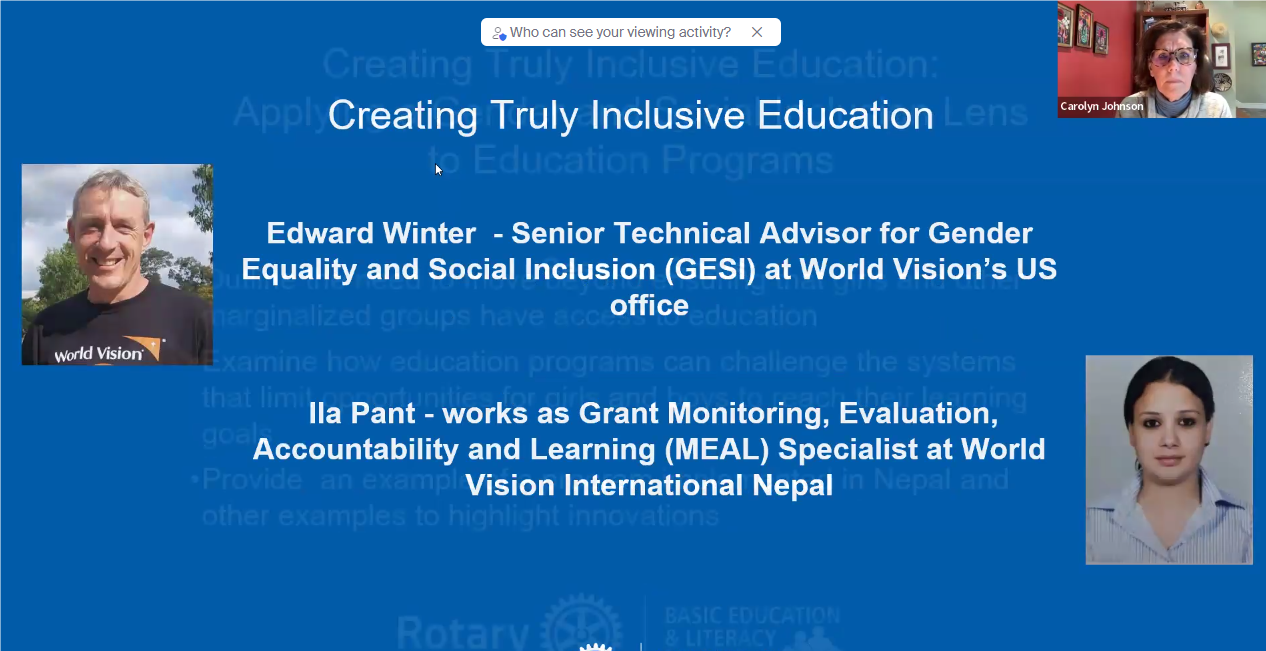
On January 16, 2025, BELRAG invited a couple of experts on Gender Equality and Social Inclusion (GESI) to present on the topic of “Creating Truly Inclusive Education: Applying a Gender Equality and Social Inclusion Lens to Education Programs.” This webinar was presented by Edward Winter, a Senior Technical Advisor for GESI at World Vision’s US office and Ila Pant who works as Grant Monitoring, Accountability and Learning Specialist at World Vision International in Nepal. These two outstanding professionals, who represented World Vision, delineated the application of gender equality, social inclusion, and the theory of change to educational and co-curricular programs designed for girls in under-resourced communities around the world and in Nepal. These presentations examined how education programs can challenge the systemic norms and policies that limit the opportunities for girls, boys, and children with special needs to reach their optimum potential.
These two presentations, attended by Rotarians and BEL experts from around the world, besides Rotary International Grant Officers and BELRAG BOD members, created an understanding of the socio-cultural and political barriers that limit the access to quality education for girls and other marginalized groups and also showcased success stories of programs that have removed these barriers. Some of these barriers stem from poverty, unemployment, the rural-urban divide, and socio-cultural malpractices like the dowry system, child marriage, and discrimination based on caste and class. Edward’s presentation highlighted the significance of engaging both the men and women in the family to support education as a mode of financial independence for their children. Edward emphasized that it’s the children who define the quality of education rather than vice versa while using global examples of transformative educational programs.
Edward’s presentation highlighted the need for women and girls, men and boys, and people with special needs to have equal access to the decision-making processes of educational systems and policies that will generate an environment of shared responsibility, collective participation, and mobilization of resources. Edward’s presentation shared a statistical analysis of the demographic, economic, and socio-cultural factors at play that cause gender inequality and social exclusion in education. Edward’s presentation demonstrated how using the GESI model of analysis can help us to identify the key issues and barriers that restrict girls, boys, and children with special needs from finding equitable access to meaningful and holistic opportunities for education.
Ila’s presentation started with an emphasis on the need to ensure girls’ access to menstrual health practices and clean toilets and emphasized the significant need for engaging parents to play a role in curbing inherent gender bias and cultural norms that restrict girls’ access to qualitative education. Ila’s presentation demonstrated how a program called Strengthening Inclusive Education in Nepal (SIKAI) engaged in teacher training to train teachers on inclusive education, co-curricular activities, and child-friendly pedagogy both for girls and boys. This program also engaged parents to coach them in giving equal opportunities to girls and children with special needs while highlighting the need to address behavioral aberrations like bullying of girls. Ila highlighted the significance of extracurricular activities like martial arts training for girls and special needs children to boost their abilities and self-confidence.
Ila’s presentation cited statistical evidence of educational programs implemented in Nepal that triggered a jump from 5% to 91.4% in the number of parents giving their girls and boys equal access to education. Ila cited the effectiveness of teacher training programs that caused a jump from 12.5% to 98.3% in the surveys that were conducted to gauge the effectiveness of teachers’ involvement in giving equal treatment to girls and boys in different aspects of education. Ila pointed out that programs like SIKAI and Government programs like “Beti Padao, Beti Bachao” (Educate Girls to Save Girls) in South Asian countries like Nepal and India have proven to have a revolutionary impact on curbing socio-cultural malpractices like Child marriage and Dowry system while using Girls’ Education as an engine of girls’ empowerment.
Last but not least, Ila shared a video that demonstrated how a program implemented in Nepal created the ripple effect of innovative education programs on the personality development of a girl named Ladli, literally meaning “the beloved.” In a poignant and powerful video, Ladli talks about recognizing her “inner power” as a result of a holistic model of education and talent inculcation to turn into a beloved figure in a conservative community. Ladli’s words in this video demonstrate how she played a role as an agent of change and empowerment who transformed the lives of as many as 1114 girls by inspiring them to get educated in an organic educational program called “Rupantaran,” literally meaning “transformation.”
My mind went back to my childhood spent in a small town amidst a conservative cultural environment in India where educating girls was not a priority or a norm in the rural areas of my home state. As a beloved daughter of parents who gave me the freedom to pursue the highest level of education as a vehicle for supporting my family and empowering an entire generation of girls in my role as a college educator, I feel grateful. I feel fortunate for a support system provided by my family, friends, and community members that enabled me to transcend the restrictive norms of gender roles to emerge as a confident woman and a college educator who could play a life-changing role, along with her colleagues, in the lives of girls and boys with the power of education. I feel equally grateful to Rotary for allowing me to grow as a human being, an educator, a writer, and an activist of “Service above Self” in my role as a Rotarian in D3054 and D3080 in India, starting in 1995. After migrating to the US and renewing my determination to be part of Rotary culture in the US, I feel grateful to be part of the culture of community service through Rotary in D6910, which enables us to touch and impact so many lives. Today, I feel honored and grateful to be a part of BELRAG and chair a Girls’ Education Team of Experts that is both brilliant and dedicated. Rotary also makes me feel whole and empowered as a mother of two who can join hands with her friends on the BELRAG Board of Directors to raise awareness on the need to promote Girls’ education, gender equity, and digital technology as tools of all-round development among communities battling illiteracy, economic deprivation and discriminatory socio-cultural norms around the world.
It’s not a cliché when we affirm that when we educate girls, we educate an entire family, and when a family educates an entire community, we see change happen all around us and it’s hard to miss the footprints of empowerment everywhere we see. My mind goes back to the Rotary International (R.I.) Convention in Melbourne in 2023, Australia where sitting next to my son Krishna, I heard and imbibed the visionary power of R.I. President Stephanie Urchick’s words when she recollected her visit to an Institute in India where bicycles and sewing machines were donated to young girls to support their access to means of livelihood, “That institute was a joyful reminder that when we empower young girls, they can go on to become empowered women who in turn empower and nurture an entire community.” Amen.
BELRAG Girls’ Education Team of Experts Webinar on January 16, 2025
Dr. Anu Narula, Chair, Girls’ Education Professional Team of Experts, BELRAG Board of Directors
BELRAG will host our first annual BEL symposium preceding the Calgary International Convention, on 20 June 2025. Join Rotarians from around the world to explore the amazing work that is being done to support Basic Education and Literacy
We will gather at the beautiful Calgary Central Library, conveniently located downtown near the convention center. Our full day will include programs that include:
why (and how) we must be literacy advocates,
how to design successful long-term programs,
working with refugee communities,
effective technology in education
and much more!
The day will include plenty of time for networking and sharing projects and ideas. Lunch and a continental breakfast are included. We will end the day with an optional (short walk) visit to the Little Red Reading House to see how Calgary promotes early reading.
It will be an informative and enjoyable day with Rotary colleagues interested in BEL. Registration is open now with a special reduced rate until 30 April ($65 USD). We are looking forward to meeting you in Calgary. Don’t miss this opportunity for a day of fellowship discussing all things literacy and education!
Register here before 30 April 2025 for a reduced rate of $65 USD.
Thank you to our sponsors:
Be A Part of BELRAG History - Join the 1st Annual BELRAG Symposium
Each year, Rotary International dedicates the month of January to celebrate the importance of vocational service—a core tenet of Rotary’s mission. Vocational Month is a time for Rotarians to reflect on the role of their professions in shaping communities and to recommit to using their skills, knowledge, and ethical practices to make a positive difference in the world. For the Basic Education and Literacy Rotary Action Group, BELRAG, this month highlights the essential role of education as we advance professional development for teachers and foster lifelong learning for all.
The Literacy Mission of Rotary: Why Educate Girls?
As per unicef.org/gender-equality, 60 million girls worldwide have no access to basic education. Of the 960 million people who are illiterate worldwide, two-thirds are women. Around 129 million girls are out of school, including 32 million of primary school age, 30 million of lower-secondary school age, and 67 million of upper-secondary school age. In countries affected by conflict, girls are more than twice as likely to be out of school as girls in non-affected countries https://www.unicef.org/. Globally, 1 in 4 girls (age 15-19) are neither employed nor in school, compared with 1 in 10 boys. As per a World Economic Forum report https://www.weforum.org/reports/global-gender-gap-report-2021, women all over the world continue to face economic impediments, unequal wages, challenging workplace conditions, and exclusion from meaningful economic and political productivity. As per a new report on https://www.unesco.org/en, the costs for gender gap in education, adds up to $10 billion a year.
Some of the critical outcomes of elevated levels of Girls’ Education include:
Better employment opportunities leading to greater levels of financial independence among girls. In the US, for example, the mean earnings for women in 2021 stood at $65,987 per year. However, there was a difference of $97,380 in the income of women with a high school diploma versus a professional degree https://www.statista.com/. An extra year of secondary school for girls can increase their future earnings by 10 to 20 percent.
STEM and digital literacy as pivotal tools for lucrative careers for girls. The global participation of women is much lower than men in the STEM workforce. As per https://www.undp.org/, “Skills in STEM (Science, Technology, Engineering, and Math) are vital tools for women to play a constructive role in tackling critical and urgent sustainable development problems, ranging from climate crises to food security to gender-based violence.”
Rising graph of economic productivity in family, community, and society co-relates with girls’ education. As per https://www.usaid.gov/ (2017-20), if 10% more adolescent girls attend school, a country’s GDP increases by 3%. Cutting down the school drop out rates both for girls and boys would increase annual GDP growth by 1 to 2%.
Better Health and Wellness Outcomes for Families, including mental health and substance abuse disorders. A child whose mother can read is 50% more likely to live past age 5. Increasing educational opportunities for girls and women leads to reduced domestic abuse and violence, and a reduction in the rate of social malpractices like child marriage. Education empowers women with an increased ability to promote safe environment for children and young generations to thrive https://www.annualreviews.org/content/journals/criminol/1/1 (2018).
In BELRAG, we see, more and more often, the efforts made by Rotarians to work with groups of children who have not had opportunities to learn in the same ways most children worldwide have had. The school buildings are not structurally sound, the distance between home and school is very far, and the teachers who work with the children do not have adequate supplies or professional opportunities to improve their skills. Projects planned to correct these challenges can have positive, lasting effects on a community.
As Rotarians work in more remote Indigenous communities worldwide, we must consider the appropriate methodology and cultural sensitivity in our work with the communities, the teachers, and the students. Many Indigenous people continue to live as their ancestors lived, away from the norms of the broader worldwide communities. However, their lands have often been reduced in size, their languages decimated, their access to traditional food and food sources has become limited, and their value as a nation does not have the equal respect of others - both outside the community and sometimes within the community.
Looking at these communities through the lens of Rotary's values causes us to be resourceful, respectful, and cautious when introducing or emphasizing our values into an existing standing set of norms within the community in which we work. We often have groups of Rotarians and/or Vocational teams of educators trying to help isolated communities of teachers and students. It is much too easy to use the methodology of the rest of the country where this indigenous population now lives or the methods with which the Rotarians are familiar. This article offers some suggestions that are considered developmentally appropriate for the children, not only in terms of teaching methodology but also in terms of cultural norms.
We all like to learn in a pleasing environment, but not all children have this advantage. Establish your respect for the culture by creating a more stimulating space using photographs, artwork, and spaces for dancing and singing. Welcome community members to contribute and participate with the children. These become opportunities for reading when you write out the words and do a choral reading with them. Create illustrated songbooks or posters.
When planning literacy activities, we begin with language. Our oral language skills develop from birth as we are exposed to conversations, laughter, and music within the home, whether directed to the infant or just normal chatter. Many children in indigenous communities have been introduced to two distinct languages, either in their homes or when they begin school. This is considered an advantage in brain development because it has expanded that child's capacity to learn how language works. Still, it is critical to acknowledge and work with the children’s first language, which the community needs to keep alive. While in the long term, reading and writing will probably be in the language of the broader community or country, it is still important for children to learn to speak and read in the language of their home community. The craft and process of reading is about translating oral ideas to written text, so the language used can be either. The real advantage of reading stories in a child's home language is that sense of belonging, a historical context, and, most importantly, accessing comfortable and familiar stories. The community elders undoubtedly know stories through their oral traditions, which can often be documented and Illustrated for children to read. What a great service Rotarians would offer a community if they could help elders write appropriate books for children and have them published for the children to read.
There are many ways for children to see their thoughts and ideas put into print. Their stories can be documented on chart paper, on loose-leaf pages, or as an accompaniment to their artwork. Printing some of the stories in book form would be a lasting legacy of a Rotary BEL project. Acknowledging the culture and the language, with the support of the elders, adds an entirely different dimension to a literacy project. Consider how this could also become a source of financial assistance to the project. There is always support for making culturally appropriate resources available for purchase. With the financial aid of local Rotary Clubs, there are many opportunities to expand on these ideas and build cultural bridges between the indigenous and non-indigenous groups.
Education begins long before a child attends a formalized school setting. We learn to listen, speak, formulate, and articulate ideas. We learn the specialized language of mathematics, science, or conservation through hands-on, everyday activities at home. A child brings a wide range of resources to school with them, but teachers do not always respect a child’s learning process or the knowledge possessed and demonstrated by the child. Once children are at play, they use the opportunity to contextualize the vocabulary they have heard in their homes, communities, and schools. This is why in programs for young children, from preschool to kindergarten or first grade, it is important to allow children to expand their thinking and vocabulary in relation to the activity. For example, if a child plays at a water table with little or no equipment, it is still easy to observe how the water moves when the table is bumped or slightly lifted. When an adult or another child is available to identify appropriate vocabulary alongside the activity, children understand that relationship. Watching water move from one end of the table to the other when the end is lifted can lead to children understanding how ramps can be created to move materials faster and easier. The idea of an inclined plane at this level can be physical, but the child does not necessarily need to know the scientific labels. Some children will want to know the word, some will remember and use it, and some will just have fun with the movement. These are all activities that children can participate in with very few materials.
Setting up a home center in an early-year classroom allows children to enact relationships between, say, older members of the family and younger children, between parents, or between children. Helping a community that lives in a slightly different way to the larger population of a country to validate their language, ways of thinking, and expressing themselves. This strengthens the bonds between members of that community. It will help children be proud of the culture they were born into. Rotarians working in these communities should encourage the teachers of young children to incorporate child-rearing practices of the community and build those into the children's play, thus respecting the culture. For example, children in Vanuatu or other Eastern island communities should have access to shells to create art similar to the art of adults in the community.
Research the culture and develop cultural adaptations appropriate to the children's needs. Let Rotary be known for its respect for the cultures in which it works. Partnering with local Rotary Clubs is critical in creating an international project that makes a difference.
Developing Literacy Projects in Indigenous Communities
In this story, Dr. Anu Narula, a member of the Basic Education and Literacy Rotary Action Group (BELRAG) Board of Directors and BELRAG Ambassador for District 6910, shares several book donation projects. Rotary clubs around the world can implement these projects at a relatively low cost to promote early learning and basic literacy through the love for book reading among elementary school children in our home districts and in global communities on the African continent.
The purpose of the chart is to illustrate the connection between basic education and literacy and the pillars of positive peace. It explains how education and literacy contribute to building and sustaining peace by promoting equitable opportunities, reducing corruption, empowering informed decision-making, and fostering understanding and collaboration among communities. Each of the pillars in the diagram highlights a specific aspect of peacebuilding, such as equitable resource distribution, a well-functioning government, and good relations with neighbors, emphasizing how education underpins these factors.
This chart aims to promote the idea that improving education is critical for creating a more peaceful and inclusive society. It appears to be associated with Rotary, the Institute for Economics and Peace (IEP), and the Positive Peace Activators initiative.
Basic Education for Economic Growth and Reducing Poverty
Activity: Entrepreneurship Simulation Organize a classroom project where students create mock business plans for their community. Focus on problem-solving skills and writing proposals. Students can present their ideas to "investors" (teachers or peers).
Activity: Financial Literacy Workshop Teach basic budgeting and savings concepts through interactive games like “Design Your Dream Budget.
Education and Literacy for Transparency and Accountability
Activity: Role-Playing Civic Responsibility Students role-play scenarios about corruption and accountability (e.g., reporting misconduct). They can write persuasive essays or letters demanding fair practices.
Activity: Mock Election or Debate Conduct an election or debate around a classroom issue to emphasize fairness and informed decision-making.
Promoting Fairness and Reducing Inequalities
Activity: Equity Awareness Game Design a resource allocation simulation (e.g., dividing “classroom resources” unequally and then rebalancing). Discuss fairness and solutions.
Activity: Literature Discussion on Inclusivity Read stories that showcase diverse experiences and hold discussions about the characters’ challenges and strengths.
Informed Societies for Better Decision-Making
Activity: Media Literacy Exercise Have students analyze articles or news stories to identify facts, opinions, and bias. Create a classroom newsletter with researched, balanced reports.
Activity: Community Survey Project Students design surveys to gather opinions on a local issue, analyze results, and present recommendations.
Learning About Cultures for Acceptance
Activity: Cultural Exchange Day Assign each student or group a country to research. They create presentations including traditions, history, and language, fostering acceptance.
Activity: Storytelling Circle Invite students to share personal or cultural stories, focusing on lessons about respect and understanding.
Education for Problem Solving and Innovation
Activity: Problem-Solving Challenge Provide real-world challenges (e.g., environmental issues) and have groups brainstorm innovative solutions, presenting their ideas in a written format.
Activity: Collaborative STEM Projects Link STEM skills to literacy by having students explain their experiments or designs in detailed reports.
Building Communication, Collaboration, and Conflict Resolution Skills
Activity: Conflict Resolution Role-Play Practice resolving fictional conflicts through effective communication techniques. Students can write scripts for their role-plays.
Activity: Collaborative Writing Project Groups create a shared story where everyone contributes and negotiates the plot, fostering teamwork.
Strengthening Good Relations with Neighbors
Activity: Community Outreach Project Partner with local organizations to write thank-you letters or create informational posters about peacebuilding in the community.
Activity: Peer Buddy Program Pair older students with younger peers to read and discuss books that promote empathy and kindness.
Well-Educated Populace Contributing to Peace
Activity: Peace Ambassador Campaign Students create presentations or posters on how education fosters peace, emphasizing their ideas for improving education access globally.
Activity: Problem-Solving Roundtable Host a discussion on global or local issues (e.g., climate change, poverty) where students research and present solutions collaboratively.
Basic Early Literacy and Pillars of Peace Activities
Christena Essam Kamel, 19, works as a youth ambassador in her community of Ezbet Khairallah in Cairo, Egypt, because she recognizes how she can help develop her community through literacy.
As part of the Feeding Minds Youth Literacy Program, funded by the Yum! Foundation and KFC (Kentucky Fried Chicken), Christena is just one of the many youth ambassadors working with ProLiteracy and partner Anba Moussa Al-Aswaad Association (ANBA) to help educate youth and young adults to build a more sustainable and healthier future for their community.
In Ezbet Khairallah, over 1 million people live in poverty, and 30% of students, mostly women and girls, drop out of school for various economic reasons. Through this three-year partnership, ProLiteracy and its partners are giving this population access to education and putting tools and resources where they are needed most.
In the first year of working with the Feeding Minds program, they reached 219 learners from the ages of 12 to 35. Literacy ambassadors framed instruction around Level 1 of ProLiteracy’s proven Laubach Way to Reading methodology, which was translated into Arabic.
Literacy gains were overwhelming across all age groups. Notably, 84% of 12–20-year-olds and 94% of 21-35-year-olds improved their literacy levels from a first-grade equivalent to being able to read at a second-grade level, recognizing letters, writing basic sentences, and reading short texts. With enhanced literacy skills, 70% of youth in the formal school system registered to take school exams to move up one grade level in this first year.
Keeping the momentum of the first year going and eliminating the barriers to education will mean these students will be more likely to stay in school, which will lead to a future with better economic outcomes, a more prepared workforce, improved health, and a more sustainable community.
As the program progresses and literacy levels grow, ProLiteracy is developing Levels 2 and 3 of Laubach Way to Reading in Arabic.
ProLiteracy is an international organization that builds the capacity of adult literacy programs to transform lives and communities. They are experts in adult education, leading the way in advancing adult literacy in the US and throughout the world.
ProLiteracy Feeding Minds Literacy Program Improves Literacy Rates in Egypt
Rotary clubs have become Community Champions and have partnered with All District Reads to distribute 100,000 books in South Hampton Roads in the last 2 years! This literacy program is very simple. Once a school division decides to participate, then every elementary student receives 2 FREE children's novels to take home and enjoy night after night, chapter by chapter, with all their schoolmates. This is home-based and led by local Rotary clubs, with a Rotary sticker in each book. It occurs across all elementary schools in a school division. It ends up being a fun division-wide children's book club. “It’s exciting to reach this milestone in just two years—giving 100,000 books to start literacy fires in homes,” said All District Reads Founder and Rotarian Gary Anderson.
All elementary families in Suffolk Public Schools read School Days According to Humphrey by Betty G. Birney, while elementary families across Norfolk Public Schools read Frindle by Andrew Clements. Families of students in Portsmouth Public Schools shared the Adventures of Cleo Edison Oliver, Playground Millionaire by Sundee T. Frazier. An audio version accompanies the paperback version so the whole family can listen together as an option. Rotary clubs meet and place Rotary stickers in all 100,000 of the FREE books. It's a win for the children and their families and for the whole community.
The mission of All District Reads is to partner with public school districts and communities to foster family literacy. All District Reads partners with schools, Rotary Clubs, and participating communities to encourage reading aloud in households and classrooms of all Kindergarten through 5th-grade students, with special advantages for low-income students. The ADR reading program provides a shared reading experience within homes to promote literacy and create a passion for reading.
Children born into poverty face numerous challenges, including a deficiency in literacy skills. Research indicates that children raised in households with books gain a significant edge compared to those who do not have access to books.
To learn more about how your club or district can replicate this program, contact Gary Anderson at garya50@aol.com.
South Hampton Roads Rotary Clubs Distribute Over 100,000 Books to Elementary Schools In 2 Years!
The intersection of literacy and peace – transforming lives one child at a time
Vasanthi Ranganathan
By Vasanthi Ranganathan, a member of the Rotary Club of Ambattur, India; Rotary Positive Peace Activator; member of The Rotary Foundation Cadre of Technical Advisers, member of BELRAG, and member of the India chapter of the Rotary Action Group for Peace.
As Rotary celebrates the intersection of literacy and peace this year, I am reminded of the importance of understanding both negative and positive peace. In today’s world, where there is so much information overload, media literacy is crucial. Teaching nonviolent communication as part of our literacy efforts helps foster new perspectives and build leadership skills centered on peace.
I have always found peace and conflict prevention an exciting and rewarding space. As a Rotarian, a Rotary Positive Peace Activator, and a member of the Cadre, I have been privileged to help motivate others to dream, discover their full potential, and make a lasting impact on the world.
My journey in empowering marginalized communities and fostering peace began at an early age with simple acts of empathy – listening and mingling with those different from me. As an 11-year-old, I remember visiting a mental health care hospital, as my school program, to entertain the residents, and later became involved as a volunteer in the field of mental health. These early experiences, combined with engaging in sports activities with children in government schools, children whose parents were in prison, and orphans, taught me that working with youth in their formative years on inner peace translates into peaceful actions and behaviors.
At age 16, I married for love, crossing caste boundaries in a society where such a union was unheard of. Born into the highest caste, convent-educated, English-speaking, I chose to marry a man who was different, everything society objected to – tall, dark, non-vegetarian, and a school dropout. Together, we had two beautiful children, and our life became a mission to address poverty, empowering individuals to discover their potential, dare to dream, and deserve to win.
My first major step beyond India was pursuing management education at the University of Connecticut in Hartford, USA, as a Rotary Ambassadorial Scholar at age 30. Leaving my two young children behind, I embarked on a journey that opened my eyes to the world’s misconceptions about India – caste, dowry and gender-related abuses were often the only things people knew. It was surprising to learn that many Americans weren’t aware that India granted women the right to vote alongside men, long before the U.S. or even Rotary allowed such inclusion.
I continued my studies at the East-West Center in Hawaii, pursuing a doctorate in counseling and guidance. Practicum and internships in American schools, particularly with military populations, enriched my understanding of peace and education. At Hawaii, I was given the Makana award in 1988 for my work.
I went back to India in 1991, working as an educational and management consultant. After visiting Malaysia for consultancy, I introduced the Abacus learning method as an after-school support center for children ages 3-14. This method employs kinesthetic, auditory, and visual elements to increase a student’s speed and accuracy. We turned local resources into ventures that promoted access to education while also creating business growth and community development.
My focus has always been on fragile, vulnerable communities – children whose parents are in prison, victims of war, the dependent elderly, and stay-at-home women assigned that role by their culture. While advocating for inclusion at higher levels, I’ve learned the importance of teaching these individuals to seek and demand their rightful place. Gender discrimination has been a part of my journey, but I’ve gained confidence and strength through my leadership experiences.
Over the years, I’ve learned key lessons essential to any peacebuilder: the importance of engaging a local culture and involving the community so they can take ownership of an effort and not just remain passive recipients. When we seek to build a legacy by helping others improve their situation, we create peaceful communities that can carry on creating change.
Becoming a Rotary Positive Peace Activator for the Asia cohort has been an incredible journey. It opened up new worlds of work, introduced me to extensive peace curricula and resources, and exposed me to countless training opportunities. Networking with my Asia cohort team and connecting with activators from other regional cohorts has broadened my own personal vision and strengthened my connections, helping me learn and replicate models.
As a member of the Cadre, I’ve had the privilege of auditing and consulting on numerous global grants. My role often includes emphasizing the importance of inclusion and the eight Pillars of Positive Peace. Workshops train teachers in self-esteem and inclusion. These enable peers to work together in peace and allow parents and the community to serve as stakeholders in the education process. Teaching youth skills like negotiation, arbitration, and mediation equips them for creating a better future for themselves and others, one that recognizes that investment and productivity only happen in peaceful communities.
Despite the challenges our world faces, I find motivation in the simple, constant rhythms of nature like the sunrise or the waves returning to the shore. These daily reminders encourage me to rise again, even after moments of despair. Education can transform lives, even if it’s just one child at a time, and there’s so much more we all can do.
Today, at 72, I choose to live happily, finding joy in the smiles and warm gestures of those whose lives I’ve touched. The journey continues, and I’m grateful for every step I’ve taken, and for all the steps ahead as I continue to follow my journey of purpose.
Article courtesy of Rotary Voices Blog, October 16, 2024.
The intersection of literacy and peace - transforming lives one child at a time
As we celebrate the Economic and Community Development month and the International Day of the Girl Child in October, let’s take stock of the ways in which we can convert Rotary’s agenda of Girls’ Education into a vehicle for empowering our families and communities through our programs.
The Rotary Club of Nairobi-Langata (RCL) has been implementing computer labs in underserved public schools through its Digital Literacy Program for Schools (DLP). The scope of the project includes refurbishing and enhancing security in a preexisting structure (classroom), procuring computers, installing a management system, and learning content, training teachers, and providing technical support to ensure long-term sustainability.
The Covid-19 pandemic accelerated the global movement towards digitization however many young people in rural communities and in vulnerable, underserved areas of Africa were being left behind in the drive towards digitization, due to the high cost of internet access, the lack of consistent electricity supply and a lack of infrastructure that would support digital learning. As a result, students were growing up unprepared for the digital future that awaited them.
As a result, RCL conceptualized their flagship project and dubbed it Digital Literacy Program for Schools (DLP). The objective of this project was to improve access to digital literacy for the rural poor children and close the digital divide while providing them with skills to make them able to work, learn and compete in an increasingly digital world.
RCL's project addressed these gaps by equipping schools with computer labs, helping students prepare for a digital future while contributing to the UN Sustainable Development Goals (SDGs) such as Quality Education (SDG 4), Gender Equality (SDG 5), Decent Work (SDG 8), and Industry Innovation (SDG 9).
The short-term goal was to provide digital literacy and access to 5,000 students and 100 teachers between 2022-2024 while the long-term goal is to help students become competitive in the global digital economy.
Realized Outcome & Impact of the Project
Since the launch of the initiative in the year 2022:
Seven (7) laboratories implemented across Kenya.
Thirty-Five (35) teachers trained as part of project implementation.
Sixty (60) teachers trained through peer tutoring by the teachers trained during the implementation stage.
Four Thousand Nine Hundred (4,900) Students provided with digital literacy and access to computers.
Students are now able to visualize geographical and biological phenomena they could only read about.
Average School Grade Performance has increased by a minimum of ten (10) points for the schools who have undergone the national examination cycle as well as internal school examinations since implementation.
RCL has seen improved student performance, increased teacher competency, and enhanced school administration through digital tools.
Sustainability
Every project involves community participation, leveraging alumni and parental support, and regular training to ensure the continued operation and maintenance of the labs. Continuous monitoring and evaluation to assess the impact, including academic performance and digital literacy gains.
The FUTURE of the Digital Literacy Program for Schools (DLP)
THIS Rotary year 2024/2025, we intend to implement ten (10) computer laboratories across the country at an average cost of USD 35,000 per laboratory.
In this way we intend to continue the work that was started in 2022 when we launched our first Computer Lab - To contribute to the reduction of acute ICT infrastructure and skills shortages currently facing public schools - enhancing the ability to compete in the global economy.
For us to replicate the gains we have seen so far, we are seeking financial support / partners for Global Grants OR Club to Club grants from Rotary Clubs who are enthusiastic about supporting projects in the area of focus of Basic Education & Literacy.
For more details on how you can support or partner with this impactful initiative, please visit our website www.rotarycluboflangata.org or contact our International Service Chair (Immaculate Mwake) or Grants Chair (Maureen Gichuhi) via the following email addresses: internationalservice@rotarycluboflangata.org, grants@rotarycluboflangata.org
Maureen Gichuhi mgichuhi76@gmail.com Rotary Club of Nairobi-Langata Nairobi, Kenya (D9212)
Rotary Club of Nairobi-Langata - Digital Literacy Program for Schools (DLP)
Our first month-long celebration of Rotary Basic Education and Literacy projects was successful! Thank you to the presenters who shared with us their excellent projects in K-12 education, adult literacy, education disabilities, and libraries to name a few. Thank you to the attendees for showing up. We hope you were just as wowed by the projects as we were. We aim to have all the videos uploaded to the BELRAG website within the month so you can watch the ones you missed.
Our purpose in creating this webinar series was to raise awareness of the many basic education and literacy projects in which Rotary clubs and districts are participating. We hope you learned about a project or projects that you can replicate in your community…and the work has already been done. In addition to uploading the videos, contact information for each webinar presenter will be provided on our website. Reach out to them for information and help.
Here is a list of the webinars presented:
List of Rotary Clubs and their Webinar Titles
Rotary Club Name
Location / District
Webinar Title
Club Rotario de Salinas Spondylus
Ecuador, D4400
Rotary Rolling Library
Rotary Club of Ambattur
India, D3234
BEL Projects Ideation
Rotary Club of South Park
USA, D7680
Small but Mighty
Rotary Club of Austral
Chile, D4355
Collaboration: The key to BELRAG service
Club Satélite de Guatemala La Reforma
Guatemala, D4250
La Biblioteca Viajera
Rotary Club of Scarborough
Canada, D7070
Bright Futures: Empowering Every Child’s Potential
Rotary Club of Abuja Maitama
Nigeria, D9127
Basic Education for Young Children
Rotary Club of Tygerberg
South Africa, D9350
Foundation Phase Empowerment
Rotary Club of Nassau Sunrise
Bahamas, D7020
Kindergarten Literacy
Rotary Club of Chinchorro
Chile, D4320
Artes en las ciencias
Rotary Club of Playa Coronado
Panama, D4240
RACHEL in Panama
Rotary Club of Chinchwad Pune
India, D3131
Education
Rotary Club of Gaithersburg
USA, D7620
Literacy for Youth and Adults
Rotary Club of Denton, Texas
USA, D5790
Autism Training for Elementary Teachers
Rotary Club of Whitby
Canada, D7070
Empowering Indigenous Youth in Guatemala
Rotary Club of Dhanbad
India, D3250
Jeevan Jyoti School
Rotary Club of Las Vegas WON
Rwanda, D5320
Afrikan Baby Book Project
Rotary Bangalore West
India, D3192
Adult literacy program
Rotary Club of Global Passport
Canada, D6330
Yorkwoods After School and Homework Program
Club Rotario de Panamá
Panama, D4240
Imaginando una Educación para Cambiar Vidas
Rotary Club of Little Rock Afterhours
USA, D6150
Rotary Reading Ladder
Rotary Club Of Milimani
Kenya, D9212
WASH Borehold Program for Public Schools in Kenya
Rotary Club of Ranch Bernardo
USA, D5340
Educating with a World Standard
Rotary Club of Ranch Bernardo
USA, D5340
Learning Upgrade Educating Migrant Children
Rotary Club of Alpharetta
USA, D6900
Rotary Success: Empowering Down Syndrome Persons and Their Families in Rio Grand do Sul.
A Celebration of Basic Education and Literacy BELRAG Webinar Series Weekly Agenda – Final 2 Days
Sunday, September 29 – 9:00 AM
Presenter: Yeddah B Machage Club: Rotary Club Of Milimani Country: Kenya Title: WASH Borehole Program for Public Schools in Kenya Objective: The project tackles critical WASH shortfalls in schools previously operating below WHO-daily recommended water supply per person. This deficiency not only strained resources but also jeopardizes the institution's health standards and education programs.
Sunday, September 29 – 9:00 PM
Presenter: Karen McDaniels Club: Rotary Club of Denton, Texas Country: USA Title: Autism Training for School Teachers Objective: Provide Elementary School Teachers Scholarships to Learn Applied Behavior Analysis
Monday, September 30 – 9:00 AM
Presenter: Janet Greiner Club: Rotary Club of Gaithersburg, Maryland Country: USA Title: Literacy for Youth and Adults Objective: Training teachers in Cultural Restorative Literacy to teach adults
Monday, September 30 – 9:00 PM
Presenter: Karen McDaniels Club: Rotary Club of Denton, Texas Country: USA Title: Autism Training for School Teachers Objective: Provide Elementary School Teachers Scholarships to Learn Applied Behavior Analysis
A Celebration of Basic Education and Literacy BELRAG Webinar Series Weekly Agenda – WEEK #3
Sunday, September 15 – 9:00 AM
Presenter: John Vianey Club: Rotary Club of Anchalummood Country: India Title: Provide books and create library in village Objective: Availability of reading and study materials
Sunday, September 15 – 9:00 PM
Presenter: Courtney Doldron Club: Rotary Club of Global Passport Country: Canada Title: Yorkwoods Afterschool and Homework Program Objective: To motivate learners and have them complete their homework
Monday, September 16 – 9:00 AM
Presenter: Alex Robertson Club: Rotary Club of Rancho Bernardo Country: USA Title: Educating with a World Standard Objective: Creating a sustainable standard of education for emerging nations
Monday, September 16 – 9:00 PM
Presenter: Alex Robertson Club: Rotary Club of Rancho Bernardo Country: USA Title: Learning Upgrade Educating Migrant Children Objective: The sustainability of education for migrant children remains the driving objective
Tuesday, September 17 – 9:00 AM
Presenter: Rajendra Rai Club: Rotary Club of Bangalore West Country: India Title: Adult Literacy Program Objective: To transform Adult illiterates to literates so that they could read write and count
Wednesday, September 18 – 9:00 AM
Presenter: Wesley Manus Club: Rotary Club of Little Rock Afterhours Country: USA Title: Rotary Reading Ladder Objective: Foster literacy engagement among elementary students
Thursday, September 19 – 9:00 PM
Presenter: Janelle Cambridge Club: Rotary Club of Nassau Sunrise Country: Bahamas Title: Kindergarten Literacy Objective: Enhance the foundational literacy skills of students performing below grade level
Friday, September 20 – 9:00 AM
Presenter: Danielle Harder Club: Rotary Club of Whitby Country: Canada Title: Enpowering Indigenous Youth in Guatemala Objective: The Guatemala Groundswell Program encourages Maya youth to stay in school
Friday, September 20 – 9:00 PM
Presenter: Dahiana Barzola Chávez Club: Rotary Club of Salinas Spondylus Country: Ecuador Title: Rotary Rolling Library Objective: Promote the reading habit in boys and girls through the rolling library
Saturday, September 21 – 9:00 AM
Presenter: Bob Koncerak Club: Rotary Club of Alpharetta Country: USA Title: Rotary Success: Empowering Down Syndrome Persons and Their Families in Rio Grand do Sul Objective: To highlight and celebrate the shared accomplishments of Rotary, governments, businesses, and individuals for a Down Syndrome Training and Education Center
Saturday, September 21 – 9:00 PM
Presenter: Yolanda Castillo Club: Rotaract Boquete Country: Panama Title: Ally of Education Objective: Guarantee the right to learning with quality and equity of children and youth in 18 schools in the district of Boquete, through biosafe spaces with infrastructure, nutrition and counseling of educational parents.
As we celebrate the Rotary theme of Literacy and World Literacy Day in September, let’s dwell on the role of literacy in our lives and the lives of those who depend on us or touch our lives every day.
Everyone knows that the trajectory of literacy, basic education, and higher education enables us to lead productive, meaningful, happy, and lucrative lives. Literacy is one of the most vital fundamental human rights, which opens up the doors of opportunity for all-around growth and betterment in all spheres of life, including the pursuit of a productive career, mental and physical health, and the well-being of our families.
As per the UNESCO website {https://www.unesco.org/en/days/literacy}, “Literacy is a foundation for people to acquire broader knowledge, skills, values, attitudes, and behaviors to foster a culture of lasting peace based on respect for equality and non-discrimination, the rule of law, solidarity, justice, diversity, tolerance, and harmonious relations with oneself, other people, and the planet.” The theme for this year’s UNESCO International Literacy Day celebration, first celebrated by UNESCO on September 8 in 1967, is “Promoting Multilingual Education: Literacy for Mutual Understanding and Peace.” As per this website, “There is a pressing need to harness the transformative potential of literacy for promoting mutual understanding, social cohesion, and peace. In today’s world, in which multilingualism is a common practice for many … such an approach can help promote mutual understanding and respect, while solidifying communal identities and collective histories.”
Rotary International (R.I.) has consistently reiterated and acted upon the mission of literacy and education as a vital tool that can empower under-served communities in all seven areas of focus. The fact that literacy is the single most powerful medium for the Girls’ Empowerment movement can never be an overstatement. R.I. has supported a host of programs around the world that have alleviated the level of illiteracy in different countries by providing the resources and infrastructure needed for literacy and basic education. If we take a look at the global statistics of literacy rates, we will know that 90% of all males and 82.7 % of all females above the age of 15 are literate. As per [https://worldpopulationreview.com/], developed nations are cited as having an average of 96% adult literacy rate, while the least developed nations that are in the African continent and Afghanistan, manage an average of 65% literacy rates. In the aftermath of the coronavirus pandemic, 24 million learners might never have returned to formal education, including 11 million women and girls. In 2022, at least one of the 7 adults aged 15 and above (765 million) lacked basic literacy skills. Millions of children in underserved communities around the world are struggling to acquire minimum levels of proficiency in reading, writing, and numeracy. Around 250 million children of 6-18 years of age are still out of school {https://www.unesco.org/en/literacy}.
Since its inception in 2011, the Basic Education and Literacy Rotary Action Group (BELRAG) has supported programs that alleviate illiteracy, enhance literacy teaching and learning, and provide the materials and equipment needed for literacy education. The primary goal of BELRAG is to increase the global awareness of the severity of illiteracy, assist Rotary and Rotaract clubs for increasing their participation in projects that alleviate illiteracy, and establish effective partnerships for promoting the literacy programs that intersect with other areas of focus. As per the BELRAG website {https://belrag.org/}, some of the strategies that BELRAG uses to achieve its goals is to publicize the extent and consequences of illiteracy in terms of human experience and welfare through its website, newsletters, and webinars; involve Rotary clubs and their partners to promote the mission of BELRAG; develop support systems for BELRAG activities; and develop productive relationships with non-Rotary organizations and agencies, like the International Reading Association. Some of the partners of BELRAG include A Global Voice for Autism, mEducation Alliance, Rotary India Literacy Mission, Save the Children, and Speaking Books.
Each year, BELRAG awards four awards of $500 each for BEL projects from around the world. Rotary clubs are encouraged to apply at:
In conclusion, literacy can play a transformative role in creating awareness of the need to use it as an antidote to poverty, gender and racial disparities, domestic and sexual violence, sexual trafficking, economic disempowerment, class conflicts, and a variety of health crises prevalent in different parts of the world. As a newly appointed member of the Board of Directors of BELRAG, the Girls’ Education Chair of BELRAG, and a BELRAG Ambassador for D6910, it’s my honor to encourage clubs in my home district to celebrate the “Magic of Rotary” by organizing both the International Day of Peace and World Literacy Day events in September. District Governor (2024-25) Bobby Hildreth calls upon our Rotary and Rotaract clubs to plan and implement projects that use the power of literacy and basic education as a tool for uplifting and empowering our communities. To share the vision of R.I. President (2024-25) Stephanie Urchick on the pivotal role of education and literacy as one of the areas of focus in Rotary International, in her own words {https://rotary5910.org/stories/stephanie-a.-urchick-ri-president-message}, “But we all know that our work isn’t finished yet. It can’t be, as long as … education is still treated as a privilege rather than a right…” Amen.
Students participate in a class exercise. Teachers practice using the equipment and learn innovative methodologies that use technology to enhance instruction. Santiago, Panama.
The journey to creating meaningful change often starts with a simple act of kindness. Our project to establish interactive digital classrooms in primary schools was born from such a moment. We started by visiting local schools to distribute backpacks to children, a service activity focused on providing students with essential supplies. While the initiative was well-received, it quickly became apparent that a more significant solution was needed to address the deeper challenges within the schools. After conducting a community assessment, it was clear there was a growing digital gap and the need to improve the quality of education. We gathered support from all the Panama’s Ministry Education information technology technicians, teachers, students, administration, and most importantly, that of the Rotary Basic Education and Literacy Rotary Action Group and The Rotary Foundation Cadre of Technical Advisers, so that together, they could help us design the best intervention. On a continuous basis throughout the development and the implementation of the project, we received their advice, bringing additional value and outside expertise as valuable participants of the project.
From providing assistance to increasing impact
Our initial efforts were short term in nature—providing immediate, tangible support to students. However, we recognized a pressing need: the digital divide between public and private schools was stark and growing. Many students lacked access to the technology that has become essential in modern education, leaving them at a disadvantage compared to their peers in more affluent areas.
Rotary Action Group member Enedelsy Escobar assists student Enoc Vasquez with his classwork.
The public education system accommodates 88% of Panama’s student population, of which only 40% have access to internet and 30% access to computers. In the private school system, with only 12% of the student population, 90% have access to the internet and 75% have access to computers. The Covid-19 pandemic made this divide more evident when 45% of public schools were completely disconnected and did not offer classes, unlike private schools where students adapted to virtual lessons and were able to continue their learning from home. This finding was the foundation for the interactive digital classroom project.
The goal was clear: to close the digital gap and enhance learning outcomes for students in public schools by integrating technology into their daily education. We envisioned classrooms where digital tools helped foster engagement, improve comprehension, and ultimately provide students with the skills they need to thrive in a digital world. The project could not succeed without considering teachers’ digital competencies. We organized a comprehensive learning program for teachers to provide training to many teachers from schools with and without interactive classrooms to help prepare them if they switched schools or for when the program expanded to their school.
Positive outcomes: a look at the early results
Instructor Benjamin Benitez and student Victoria Perez point to a region on the map on the digital whiteboard.
The implementation of the interactive digital classrooms has already shown promising results. Preliminary data indicates a noticeable improvement in reading comprehension among students in the participating schools. The interactive elements of the digital tools have made reading more engaging, helping students better understand and retain information.
The Aprendamos Todos A Leer (Let’s All Learn to Read), a diagnostic test on reading comprehension, has shown that schools with the interactive classroom have performed better in the test when compared to similar schools without the interactive classroom. Now we are focused on strengthening the evaluation of student’s performance in schools with interactive schools versus those in schools without the classrooms.
Student Danielis Morales clicks on an icon on the digital whiteboard.
But the impact goes beyond academic performance. Teachers have observed a significant increase in student motivation. Students who previously showed little interest in class are now eager to participate. The digital classroom’s interactive nature has transformed learning from a passive activity into an engaging, dynamic experience. This newfound enthusiasm is not only improving individual student outcomes but also creating a more vibrant and participatory classroom environment.
Empowering teachers and engaging parents
Instructor Jilma Serrano assists her student Andrea Florez. Teachers practice using the equipment and learn innovative methodologies that use technology to enhance instruction.
The project has also had a positive effect on the teachers, who find teaching with digital tools more enjoyable and effective. The interactive classroom environment allows for a more personalized approach to teaching, enabling educators to cater to the diverse learning needs of their students. This has made the teaching process not only easier but also more fulfilling, as teachers see their students actively engaged and making progress.
Parents, too, have become more involved in their children’s education. Introducing new teaching methodologies has sparked their interest, leading to increased participation in school activities and a greater emphasis on supporting their children learning at home. This heightened parental engagement provides students with the critical support they need at home to succeed in school.
Bridging the divide: A win-win for all
Students Roberto Ortega, Nazareth Garcia, and Ruth Garcia work collaboratively on Ruth’s laptop.
The interactive digital classroom project has proven to be a win-win for everyone involved. By helping close the digital gap between private and public schools, we are contributing so that students and teachers have the tools they need to succeed in the 21st century. The project has not only improved learning outcomes but also fostered a more inclusive and equitable educational environment.
As we continue to expand this initiative, we remain committed to our mission of making a lasting impact on the lives of students, teachers, and the broader community. The Interactive Digital Classroom project is a testament to what can be achieved when we shift our focus from providing materials to creating meaningful, long-term impact in the lives of our children.
Beyond Donation: Creating Lasting Impact in Panama's Public Schools
Presenter: Dahiana Barzola Chávez Club: Rotary Club of Salinas Spondylus Country: Ecuador Title: Rotary Rolling Library Objective: Promote the reading habit in boys and girls through the rolling library
Monday, September 9 – 9:00 AM
Presenter: Vasanthi Ranganathan Club: Rotary Club of Ambattur Country: India Title: BEL Projects Ideation Objective: Harvest BEL projects through facilitation
Tuesday, September 10 – 9:00 AM
Presenter: Ian Parker Club: Rotary Club of Plymouth Roborough Country: United Kingdom Title: Literacy in a Box Objective: Enabling orphans and poor children to access an education
Wednesday, September 11 – 9:00 AM
Presenter: Wandi Steward Club: Rotary Club of Las Vegas WON Country: Rwanda Title: Afrikan Baby Book Project Objective: Delivering Africentric children's books to East African children
Friday, September 13 – 9:00 AM
Presenter: Willy Watson Club: Rotary Club of Tygerburg Country: South Africa Title: Foundation Phase Empowerment Objective: To improve learner maths/numeracy and literacy/language grades
Saturday, September 14 – 9:00 PM
Presenter: Micaela Vejaeani Club: Rotary Club of Panamá Norte Country: Panama Title: Zero TV for Babies Objective: Program discouraging the use of technology for babies
On June 25, 2024, the Rotary Action Group for Basic Education Literacy (BELRAG) held its annual meeting, chaired by Nancy Leonhardt. The meeting focused on reviewing recent achievements, discussing strategic plans, and outlining ongoing projects aimed at enhancing education and literacy worldwide. Key highlights included:
Introduction of a new website and member database
Continuation of current board members and the addition of two new board members: Anu Narula (Rotary Club of Canton, GA, USA) and Yair Velasquez Gutierrez (Rotaract Club of Boquete, Panama)
Emphasis on forming professional expertise teams to enhance engagement and support for education-related activities, with a focus on outreach, professional development, and the use of technology.
Next Steps for Members:
Suggest topics, speakers, or volunteer to lead a webinar for the September Literacy Month webinar series.
Submit qualifying projects for the Basic Education & Literacy Awards.
Volunteer for the BELRAG booth and symposium at the 2024 Rotary International Convention in Calgary.
Join the professional expertise teams (STEM, early literacy, professional development/teacher training, etc.) by contacting BELRAG.
Apply to become an ambassador for the BELRAG Ambassadors program by applying on the BELRAG website.
Express interest in joining the communication, education, or membership groups by contacting BELRAG.
Details
The meeting began with an overview of BELRAG's purpose: to support programs that strengthen communities' abilities to provide basic education and literacy for all. Nancy reported on the organization's membership growth, reaching 215 members as of June 20th, and its financial status, which saw an increase in revenue over the previous year.
Board's Strategic Plan
Carol Marcotte, a Board Director, outlined the board's strategic plan with four priorities: strengthening infrastructure, expanding reach, increasing financial partnerships, and enhancing participant engagement. She stressed the importance of adapting to changing circumstances, developing connections with other Rotary Action groups, and encouraging membership input to improve the plan.
Projects
Joan Littleford, Board Secretary, highlighted several Rotary-led projects focused on education and literacy:
The Rotaract and the Rotary Clubs in Ecuador developed the "Rolling Library," which brings reading materials to schools for a month at a time.
The Rotary Club of Blacksburg, Virginia created "Giving Hope through Literacy," a program that supports beginning and struggling readers.
The Rotary Club of Grove, Oklahoma established an education foundation that supports literacy initiatives, providing books to children who might not otherwise have access to them.
The project, "Co-Create a Better Community," was led by the Rotary Club of Golden Bonnea in Hong Kong, focusing on teaching AI to low-income youth.
BELRAG Activities
Carolyn Johnson, Chair Emeritus, highlighted the success of the technology-focused webinars and the growing interest in the professional expertise teams. Nancy introduced the new website and member database, emphasizing the resources available, including the "showcase of projects" and the "support needed" pages, and the member directory feature.
Nancy announced that the current board members, including herself, and two new members will continue their roles for another year. Plans for the 2024 Literacy Month awards were discussed, including improving application criteria and broader promotion. Carolyn introduced a new initiative to showcase Rotary members' projects globally, with daily webinars throughout September, and a BELRAG symposium in Calgary featuring exemplary projects and speakers.
Furthermore, a new BELRAG Ambassadors initiative was introduced to raiseawareness of basic education and literacy issues within Rotary clubs and districts, and professional expertise teams were established to provide resources for clubs and members implementing various projects.
Improving Education and Professional Development Teams
Nancy led a discussion on education, literacy, and professional development, with a focus on forming of expertise teams within the Rotary organization. Frank, a former special education teacher, expressed his interest in improving children's learning and his previous experience in curriculum development and staff management. Carolyn emphasized the importance of professional development for teachers and the need for outreach and support to develop global grants. The team agreed to enhance engagement within the professional expertise teams by directly asking members for their assistance and providing them with clear tasks, focusing on those attending the upcoming Symposium.
STEM Team, BELRAG Initiative, and Communication
Joan talked about her early literacy session and the challenges of literacy and technology. The BELRAG initiative, led by Nancy and Anthony Bloome, a Board Director, aimed to engage members in various groups like the communication, ambassador, and education groups.
The communication group will handle newsletters, the website, and social media
The ambassador group will plan district-specific events
The education group will explore ways to promote education-related activities.
Interested members were encouraged to get involved.
Technical Cadre Collaboration and Impactful Projects
Frank, Nancy, Joan, Tony, and others discussed their relationships with the technical cadre for grants and BELRAG, focusing on recent projects and potential future collaborations. They highlighted the importance of following grant guidelines, staff development, and the use of technology in education. The team also shared personal experiences, such as Frank's three-year project in Uganda, and proposed including these types of impactful projects in upcoming webinars. The conversation ended with expressions of gratitude and a discussion about potential new members.
BELRAG Board Members are often asked for examples of BEL projects that clubs could replicate, projects needing review by CADRE, or help in finding project partners. Our new website provides opportunities for all of these.
When you click on the 'Showcase of BEL Projects' link on the home page, you will be taken to a page that features projects submitted for sharing. Most of the currently highlighted projects represent BEL Award winners over the years. We would like to highlight your BEL projects as well.
To add an existing project:
Login to your Member page
Scroll down to Member Resources on the left
Click on the “Submit a Project” button
Select Project Type as “Showcase of Projects”
Fill out application and submit.
Once the committee has approved the project application, it will appear on the Showcase of Projects page.
The BEL Rotary Action Group recommends that before submitting a Global Grant project to the Rotary Foundation, Rotary clubs first send their completed application to BEL Rotary Action Group for review.
By selecting "Support Needed" under Project Type, a BELRAG qualified cadre member with expertise in basic education and literacy programs will work with you to conduct a review of the project application and give suggestions about how to improve the quality of the project. You may also submit a project here to solicit a partner or financial support from another club or district.
All project submissions will be reviewed to ensure they meet BEL project qualifications for showcasing.
How to Take Advantage of the New BELRAG Website – Benefit #2, Submitting Projects
As per UNICEF, 60 million girls around the world lack access to basic education. Of the 960 million illiterate individuals worldwide, two-thirds are women. Around 129 million girls are out of school, including 32 million of primary school age, 30 million of lower-secondary school age, and 67 million of upper-secondary school age. In countries affected by conflict, girls are more than twice as likely to be out of school as girls in non-affected countries. Globally, 1 in 4 girls (age 15-19) are neither employed nor in school, compared with 1 in 10 boys. As per a World Economic Forum report, women continue to face economic impediments, unequal wages, challenging workplace conditions, and exclusion from meaningful economic and political productivity. As per a press release on UNESCO, the costs for gender gap in education adds up to $10 billion a year. Cutting down the school dropout rates both for girls and boys would increase annual GDP growth by 1 to 2%.
Some of the critical outcomes of elevated levels of Girls’ Education include:
Better employment opportunities leading to greater levels of financial independence among girls. In the US, for example, the mean earnings for women in 2021 stood at $65,987 per year. However, there was a difference of $97,380 in the income of women with a high school diploma versus a professional degree (source). An extra year of secondary school for girls can increase their future earnings by 10 to 20 percent.
STEM and digital literacy as pivotal tools for lucrative careers for girls. The global participation of women is much lower than men in the STEM workforce. As per UNDP, “Skills in STEM (Science, Technology, Engineering, and Math) are vital tools for women to play a constructive role in tackling critical and urgent sustainable development problems, ranging from climate crises to food security to gender-based violence.”
Rising graph of economic productivity in family, community, and society correlates with girls’ education. As per USAID (2017-20), if 10 percent more adolescent girls attend school, a country’s GDP increases by 3%.
Better Health and Wellness Outcomes for Families, including mental health and substance abuse disorders. A child whose mother can read is 50% more likely to live past age 5. Increasing educational opportunities for girls and women leads to reduced domestic abuse and violence, and a reduction in the rate of social malpractices like child marriage. Education empowers women with an increased ability to promote a safe environment for children and young generations to thrive (source).
Girls’ education can create greater awareness and agency among women to tackle climate change. As per an article by Christina Kwauk on February 10, 2021 (Brookings), women are more prone to extreme effects of climate change and can tackle issues related to reproductive health, pro-environmental decision-making, and access to “green skills for green jobs” with a mode of education focused on the environment. A detailed review of the ways in which organizations like Greening Education Partnerships, Rotary International, and UNESCO are promoting Climate Change Education in schools is available on source. A detailed view of the ways in which Rotary, UNICEF, and educational communities are fostering sustainable living and biodiversity to global communities is accessible on the ESRAG Newsletter, source.
The Literacy Mission of Rotary: Why Educate Girls?
Yair is an Executive with LAFISE Bank. In 2020, he founded the Rotaract Club of Boquete and served as President through 2022. Yair is a member of the District 4240 Education Committee and Girls Empowerment Committee. he seeks for Panama and Latin America to have the necessary opportunities through quality, equitable and inclusive education, as a fundamental basis for reducing inequalities.
Dr. Anu Narula is a retired Associate Professor of English from Panjab University, India. She taught English at Government Colleges in the University of Rajasthan as a part of her teaching career spanning almost twenty years in India. Anu taught English as an adjunct faculty at the University of Tennessee in the US for 5 years. Anu has completed 14 years of Rotary service after serving in D3054 and D3080 in India. Anu renewed her Rotary membership in D6910 in 2018 after she married and migrated to the US. Anu is currently serving as the International Service Chair in the Rotary Club of Canton and is also serving as a member of the D6910 Public Image team. Anu is an Institute of Economics and Peace Ambassador and firmly believes that both Peace and Education are pivotal tools for empowering our communities in Rotary.
BELRAG and Collaborator Participation at 2024 mEducation Alliance Symposium
We'd be delighted to have BELRAG know about and invite organizations to present at the 14th annual 2024 mEducation Alliance annual Symposium. This year's theme is STEMtastic Adventures! and will take place September 30 - October 3rd, including Alliance Member Day on October 4 at World Bank offices. The event will include significant tracks on FLN, supporting marginalized learners, and reaching learners in challenging educational environments.
Last year's Symposium, our 13th annual, was the first global STEM education conference. We had representatives from over 40+ countries and 250 attendees join us, including participation from several Ministries of Education, such as delegations from Liberia, Ghana, and Malawi.
Global Math Prize
As part of our suite of Math Power! activities, we launched earlier this week a global math prize to recognize and celebrate non-profit organizations working to bring the joy of math to their communities. Prior to our first award in 2022, there did not exist a similar prize. We are putting US$10,000 (just got an additional $5,000, but contingent upon matching funds) into this and looking for organizations as co-funders and individual contributions through our crowdfunding campaign.
2023 mEducation Alliance Landscape Report- The BELRAG family might be interested in this landscape report of mEducation Alliance member ICT4E activities in 2023 and ambitions for 2024.
In the post COVID world, the number of children with online access has increased exponentially, and it is imperative to sensitize them about cyber hygiene and cyber risks. Since 2018, the Rotary Club of Poona West’s online safety campaign, Cyber Suraksha (Suraksha meaning Safety in Hindi and Sanskrit), has advanced cyber safe practices amongst students, teachers, parents, and school heads to create and sustain digitally secure school and college ecosystems.
The campaign is supported by the local Pune Police force as well as the State Education Board. It covers topics such as the safe use of internet devices, account security, online transactions, cyber hygiene, cyber bullying, sexual offences, social media usage, netiquettes, data security, internet dependency/addiction, and reporting mechanisms. It is conducted through online seminars (live streamed on YouTube/Facebook and asynchronously through prerecorded videos and presentations) as well as on-site interactive workshops for children, parent groups, and teachers. Project organizers also place cyber safety posters in public places where the messaging becomes apparent and visible.
On each day of October 2023, the global Cyber Security Awareness Day, campaign organizers sent online safety tips to their community. These 31 tips were very well received and the feedback has been absolutely splendid. To date, Rotary Club of Poona West’s Cyber Suraksha has reached out to more than 250,000 individuals. The project is sustainable, low cost and high impact, and it engages Rotarians as well as the members of the community in raising the bar of cyber wellness.
Understanding change is an important topic for each of us. BELRAG is collaborating with ESRAG (Environmental Sustainability Rotary Action Group), Rotary International and UNESCO for Greening Education: Getting Every Learner Climate Ready. There is an opportunity for BELRAG members to participate on a steering committee that will help define and guide Rotary members to become involved in Climate Change programs for youth. We are seeking BELRAG members to get involved in work groups that will focus on:
Greening Schools: ensuring that all schools achieve school accreditation and teacher training
Greening Curriculum: embracing life-long learning approaches to integrate climate change into school curricula, materials and pedagogy
Greening Teacher Training and education system capacities: strengthening education systems to be climate smart
Greening Communities: strengthening community resilience by integrating climate change education into lifelong learning, empowering communities to take action on climate change
If you are interested in participating with one or more of these work groups, send your name and contact information to wlrrotary@gmail.com
As a member of BELRAG, you have access to other BELRAG members around the world who have opted in to the public directory, allowing members to see each other, where they are from, and send an email. This can be a wonderful tool to reach out to other Rotarians who have an interest in basic education and literacy and find out what they are doing in their clubs and districts.
Follow these easy steps to be included in the public member directory:
Login to BELRAG.org and click on Member Area, located next to your name in the top right of the page. This will bring up your profile.
Click Edit My Profile.
Under your membership ID and term, are six tabs, beginning with Details. Click on the Details tab and edit your contact info to include our searchable directory address. This is your city and country (and state if you are in the US). This does not show your personal address. Be sure to click on SAVE.
Next, click on the Directory tab.
Scroll down to Public Website Directory Settings on the right and click on Edit.
Default on each of the items is No. Click yes for Opt in to the Public Directory and any additional contact information you want to share. At the very minimum, and in order for this to work, click yes on show searchable directory address. This will show where you are located. You can even include your social media accounts. Again, be sure to click on SAVE.
If you follow the above steps, and upload a photo, here is what your public directory card will look like:
Please help us make this website more robust and a great benefit to your BELRAG membership. The directory is a wonderful tool to reach out to fellow Rotarians and learn more about BEL projects taking place around the world. If you have questions or problems, contact Nancy at wlrrotary@gmail.com.
Watch for next month’s installment on the benefits of utilizing BELRAG.org as we discuss showcasing your BEL projects.
How to Take Advantage of the New BELRAG Website – Benefit #1, Networking
BELRAG Ambassadors are Rotarians who advocate the importance of basic education and literacy in their District.
BELRAG Ambassadors promote the vision, goals, and action plan of the BEL Rotary Action Group.
BELRAG Ambassadors serve as support to club and district leadership in BEL activities.
BELRAG Ambassadors expand the awareness of BEL issues throughout their District.
BELRAG Ambassadors help to expand BELRAG membership within their District.
BELRAG Ambassadors roles:
Serve District leadership in increasing awareness about BEL programs
Advocacy
Working with BEL Expertise Teams or Cadre of Technical Advisors, provide technical and/or logistical support
Recruit and engage BELRAG members in their District
BELRAG Ambassador’s responsibilities:
Work with District leaders to develop annual goals
Present to Rotary Clubs and at District events
Work with Clubs on BEL programs and projects
Submit reports and photos to BELRAG Ambassador Chair
Interested in becoming an Ambassador?
If you are interested in being appointed as a Basic Education and Literacy Rotary Action Group Ambassador, please complete the BELRAG Ambassador Application. The following information will be asked.
Your contact details.
Rotary details if you are a Rotarian or Rotaractor.
District in which you wish to serve as an Ambassador.
Your BEL Experience.
Your Rotary Experience.
References.
Ambassadors must be a member in good standing of BELRAG.
Ambassadors serve one three-year term and can be reappointed for another 3-year term.
Attend an annual meeting of Ambassadors via Zoom each June. Ambassadors will meet and share their experiences with their peers and BEL Rotary Action Group leadership.
Ambassadors are required to submit an annual activity report in May of each year for presentation at the Annual General Meeting held in June via Zoom.
STEM stands for Science, Technology, Engineering & Mathematics.
As you can imagine, it’s a broad field! We like this definition for STEM education adapted from the State of Virgina, USA :
What is STEM education?
Science, Technology, Engineering and Mathematics (STEM) education entails authentic learning experiences for all students with an interdisciplinary and applied approach where all fields connect in complex relationships…A strong STEM educational foundation helps to prepare our students for tomorrow’s world by emphasizing collaborative, innovative, quantitative and logical analysis rooted in a solid understanding of the interdisciplinary nature of science, technology, engineering and mathematics.
STEM literacy comes from an understanding that it takes:
· a scientific approach to observe and interpret the world;
· technology to serve as a tool to solve problems or reach a goal;
· engineering to design, test and solve a problem through the creation of products or processes; and
· mathematics to help quantify, comprehend and evaluate the problem and solution’s success.
----
There are many examples of STEM-focused activities. These range from:
· youth digital literacy skills development
· empowering girls to pursue STEM careers, including in aviation careers
· robotic clubs
· supporting foundational numeracy and math instruction
· learning specific software for social good (e.g., Youthmappers)
· Digital Interactive Classroom Project (Panama) - This project was featured in the Rotary Magazine's September 2023 issue, and you can also find more information on the project here. (Rotary Club Panama North & Rotary Club Kansas City Plaza, USA)
· Online safety campaign, Cyber Suraksha is advancing cyber safe practices amongst students, teachers, parents, and school heads to create and sustain digitally secure school and college ecosystems. (Rotary Club of Poona West, India)
We’d like to use this action page to highlight various Rotary STEM initiatives. Please fill out this form with your Rotary STEM activity. We’ll compile these and post as periodic eNews on this site.
Other STEM Resources:
What Works in Technology and Education Projects: Insights from Research, Visit this link to see the 1st recording in this series on Rotary's YouTube channel in English, with auto-generated captions in other languages. You can find here the other webinars in this series and those covering other topics. (BELRAG and Rotary International, Nov & Dec 2023)
Science, Technology, Engineering and Mathematics (STEM) as an Enabler for Development and Peace, (United Nations, February 2022)
A graduate in Pharmaceutical Sciences from Kasturba Medical College, Manipal. Kamal is the Managing Director of his family-owned Banking, Financing, and Construction Business. A member of the Rotary Club of Dhanbad, he served as the Governor of District 3250 in 2005-06.
He served Rotary International as Director in 2021-2023. He also served Rotary International as an International Training Leader twice, a Member R.I. Rotaract Interact Committee & R.I.Leadership Development and Planning Committee, RRFC, RPIC, Convener -Rotary Centennial Summit 2020, Chair- Rotary Institute 2011, Chair- GETS, Chair- Rotary South Asia Summit, Chair -Presidential Conference, Coordinator multi District PETS, among others.
He has represented Rotary International Presidents as their representative 10 times to the USA, Pakistan, Australia, Philippines, New Zealand, and Bombay.
A pioneer of Vocational Training Centers for Women, he has set up 28 such centers in his district, namely ” Saheli Centers”. He has coordinated 11 polio corrective surgery camps and two artificial limb camps. He inked the “ Aman Ki Asha” Agreement between Pakistan and India for the Healing Little Hearts Program for operating on Pakistani children in India for heart diseases. He co-founded the Shelter Kits program and Rotary India Literacy Mission .
An acclaimed orator, he has addressed more than 400 PETS / District Assemblies /Conferences and Seminars.
For his selfless service has been awarded the Service Above Self Award and Four Avenue Service Award by Rotary International. The Rotary Foundation has bestowed the Citation for Meritorious Service and Distinguished Service Award on him .
He is a level 2 major donor and Bequest Society member.
Married to Rtn. Sonal, an architect, Kamal and Sonal have two children, Khwab who is pursuing a Ph.D. in Cancer Cell Biology in Germany, and Raavishu who is a Computer Engineer working at Swiss Bank, India.
Joan Litteford is the Past President of the Rotary Club of Whitby in District 7070. During her career in education, Joan has worked in Special Education and early years education through the Toronto District School Board as a teacher and consultant, the Ontario Ministry of Education, the Ontario Teacher Union, and Scholastic Canada. Her experiences in teacher training and curriculum development have taken her across Canada and in many developing countries where she has written many curriculum documents through UNICEF. Upon retirement, Joan joined Rotary and has been interested in educational opportunities for children around the world.
I fell in love with teaching when I became an instructor at the Philippine Military Academy in 1995. Since then, my passion for teaching extended outside the walls of the Academy - volunteering to spearhead our church’s Teaching Ministries since 2013, and, RC Baguio South’s RotaRead Project since I was the club president in RY 2020-2021. Rotary inspires me to share back what has been gifted to me - my experiences in the field of education, my time and commitment - and, drives me to unconditionally grow in service.
A fourth-generation native Californian, Nancy Leonhardt moved to Little Rock, Arkansas, in 1999. Since October 2013, Nancy has served as the Executive Director of Adult Learning Alliance, Inc., the state organization for 25 community-based adult literacy councils across the State of Arkansas. Nancy’s other non-profit experience includes serving as Administrative Director for Arkansas Advocates for Children and Families and executive director for numerous other nonprofits.
A member of the West Little Rock Rotary Club, Nancy has served the club in numerous capacities, including president in 2013-2014 and again in 2024-2025. She served as District Governor for 6150 in 2017-2018. Nancy also served as Assistant Rotary Coordinator from 2020-2023. Nancy is a Rotary Major Donor and member of the Paul Harris Society and Polio Plus Society. Nancy served BELRAG as the Chair from 2023-2026 then transitioned to the Executive Director to assist with the administration and membership of BELRAG.
Nancy graduated with a degree in Urban and Regional Planning from California Polytechnic University. While she intended to pursue a career in planning, she ventured into the nonprofit world after numerous years as a stay-at-home mom and has since remained. Nancy has been married for 43 years to Darrell, and they have two adult children, Jason and Christy.
Enedelsy lives in Panamá City, Panamá, after a long career with UNICEF (United Nations Children’s Fund) which took her to live in 5 continents, occupying various positions.
Nelly, as is known by her friends, had her first contact with Rotary while working in UNICEF-Copenhagen and a Rotary mission came to Copenhagen to plan and coordinate some of the activities of the Polio campaign. Similarly, she had the pleasure to accompany a group of Rotarians who came to the immunization days in Mexico while serving there as Program Coordinator.
In her various capacities, Nelly has planned, negotiated, implemented, and monitored programs of cooperation with various governments in Latin America and Africa, which incorporated many of the areas of focus of Rotary. Several lessons have been learned in the process but most important the fact that every organization needs to have a clear, focused, and comprehensive strategic plan for the organization, allowing for the participation of the stakeholders, which requires equally clear communication strategies with all the stakeholders.
Nelly joined Rotary in 2015 and has since then occupied several positions: Director of Community Service -2016-2017, Secretary - 2018-2019, Chair of the Committee of the Rotary Foundation for the Club, President for the year 2020-2021, Chair of the District Education Committee 2022-2025, member of the Strategic Planning Committee of RI, member of the Board of BELRAG and selected to be an Action Plan Champion for Zone 25A, an initiative of RI President Elect Stephanie Urchick to make Rotary’s Action Plan irresistible at Club and District level. Nelly has been instrumental in the development of one of the Interacts Clubs in our club as new generations is a priority for the club. She has attended four World Conventions (Seoul, Atlanta, Toronto, and the Virtual Honolulu), three District Conventions, and three Institutes of Leadership. Nelly is a member of the Paul Harris Society and is a Paul Harris (+5).
Conscious of the potential that Rotary has to change the world and make a tremendous impact on the communities we serve, Nelly has committed time and energy to ensure that Rotary plans and programs reach the communities that need to be served.
Nelly is a graduate of the University of Western Ontario, London, Ontario Canada where she received a BSc in Chemistry (1972) and MBA (1975) from the Ivey Business School of the same University. In 1990 she received a Diploma in Health Care in Developing Countries from the School of Public Health of the Boston University. While working for UNICEF, she participated in several seminars and workshops to strengthen her skills in planning, monitoring, and evaluation of the program of cooperation.
I am passionate about supporting education around the world for all, for young people and lifelong learners, enabling them to live healthy and fulfilling lives that contribute to the support of themselves, their families, and economies locally and internationally.
My background in education spans over 40 years. During that time, I have taught and led in Middle School, Secondary, and Further Education in England and Scotland. I have been an assessor for the Basic Skills Quality Mark for Schools for over 15 years, brought together a strategy for a local Council area for basic literacy for all ages, and was a trained inspector and adviser for schools.
I have experience in supporting young people who have dropped out of education, through the Prince’s Trust Programme in England, which focuses on Life Skills and Basic Education. I have also run a Rotary community program to support learners who do not have English as their first language and am currently leading a Rotary Conversation Buddies Programme in a local secondary school.
STEM stands for Science, Technology, Engineering & Mathematics.
As you can imagine, it’s a broad field! I like this definition for STEM education adapted from the State of Virgina, USA (where I currently reside):
What is STEM education?
Science, Technology, Engineering and Mathematics (STEM) education entails authentic learning experiences for all students with an interdisciplinary and applied approach where all fields connect in complex relationships…A strong STEM educational foundation helps to prepare our students for tomorrow’s world by emphasizing collaborative, innovative, quantitative and logical analysis rooted in a solid understanding of the interdisciplinary nature of science, technology, engineering and mathematics.
STEM literacy comes from an understanding that it takes
· a scientific approach to observe and interpret the world;
· technology to serve as a tool to solve problems or reach a goal;
· engineering to design, test and solve a problem through the creation of products or processes; and
· mathematics to help quantify, comprehend and evaluate the problem and solution’s success.
----
There are many examples of STEM-focused activities. These range from:
· youth digital literacy skills development
· empowering girls to pursue STEM careers, including in aviation careers
· robotic clubs
· supporting foundational numeracy and math instruction
· learning specific software for social good (e.g., Youthmappers)
· Digital Interactive Classroom Project (Panama) - This project was featured in the Rotary Magazine's September 2023 issue, and you can also find more information on the project here. (Rotary Club Panama North & Rotary Club Kansas City Plaza, USA)
· Online safety campaign, Cyber Suraksha is advancing cyber safe practices amongst students, teachers, parents, and school heads to create and sustain digitally secure school and college ecosystems. (Rotary Club of Poona West, India)
We’d like to use this action page to highlight various Rotary STEM initiatives. Please fill out this form with your Rotary STEM activity. We’ll compile these and post as periodic eNews on this site.
Other STEM Resources:
What Works in Technology and Education Projects: Insights from Research, Visit this link to see the 1st recording in this series on Rotary's YouTube channel in English, with auto-generated captions in other languages. You can find here the other webinars in this series and those covering other topics. (BELRAG and Rotary International, Nov& Dec 2023)
Science, Technology, Engineering and Mathematics (STEM) as an Enabler for Development and Peace, United Nations, February 2022
Carolyn Johnson is a member of the Yarmouth Rotary Club and in 2013-14 served as District Governor for D7780. She is Chair of the Cadre of Technical Advisors and Chair Emeritus of BELRAG (Basic Education & Literacy Rotary Action Group). She is an advisor to the Rotary Foundation’s Water Sanitation & Hygiene In Schools programs and serves on the TRF Grant Model Evaluation Committee.
Carolyn is an educator with experience as a teacher, administrator, and education consultant. She was selected as a Maine Distinguished Educator. Carolyn is the Founder of the Culture of Reading Program (CORP), the early literacy component of the Guatemala Literacy Project, and is Chair of the Board of Safe Passage, an organization that provides education programs to support children and their families living in the neighborhood of the Guatemala City Dump. Both programs have strong partnerships with Rotary clubs in Guatemala, the US, and Canada.
Carolyn was honored to receive Rotary’s Service Above Self Award. Carolyn and her husband, PDG Peter Johnson, are The Rotary Foundation Major Donors. They live in Yarmouth, Maine, USA.
Sophie Nuwagira Bamwoyeraki is a High School Principal. She is a published poet and the author of numerous education resources. Her works are endorsed by the Ministry of Education and used in schools in Uganda. Sophie is passionate about education and believes that with appropriate resources, every child can excel.
Past Rotary International Director Ashok Mahajan joined the Rotary Club of Mulund over 50 years ago. The club is located in District 3140, in Mumbai, India. Ashok served as President of the club in 1982-1983 and was District Governor in 1993-1994. He served Rotary International as a Director in 2007-2009 and as a Trustee of The Rotary Foundation in 2009-2013. Other appointments include Member of the International Polio Plus Committee 2009-2013, Chairman of the International Membership and Retention Committee 2012-2013, a Member of The Rotary Foundation Fund Development Committee 2015-2018, and a Member of the Nominating Committee for President 2010-2011 and again in 2020-2021. PRID Ashok has been honored to serve as the Rotary International President Representative fourteen times. He has been awarded numerous Rotary International and The Rotary Foundation awards.
Early childhood education is a unique education field that refers to all aspects of learning from birth to approximately age 6. (Note that this age range varies slightly in different jurisdictions.) It is an integrated time of development that takes place within a child’s family, with their friends, their caregivers, and through centers for learning. The years between birth and age six are formative years and set the learning course for children. There is a popular saying that indicates everything we ever need to know, we learned in Kindergarten. This refers to the idea that we all need to learn how to: interact with others, play with friends, regulate our behavior, listen, express ideas, and develop a love of reading, math, and science. These are learning skills upon which the rest of our learning is based. It is based much more on learning behaviors rather than academic knowledge and skills.
Key principles of early childhood education include:
Early child development sets the foundation for lifelong learning, behavior, and health. Every experience in a child’s early life has an impact on his or her development now and in the future. Parents and family provide the child’s first and most critical influence on their learning and development. There are critical developmental stages through which young children typically pass. These early stages, from birth to about age 6, actually create the neural pathways that we rely on for learning the rest of our lives.
Partnerships with families and communities strengthen the ability of early childhood settings to meet the needs of young children. Families and close community members create an anchor for early child development. Participation in community programs by these caregivers and their influences reap powerful benefits.
Play is a means to early learning that capitalizes on children’s natural curiosity and excitement. Play provides a holistic approach to children’s development in all of the critical areas: social, emotional, communication, cognitive, and physical development. Children use a variety of developing skills as they engage in creative, problem-solving play such as building a tower with blocks. Using and demonstrating learning in all areas of development are all a part of this simple activity.
Social development: the ability to play cooperatively with another child
Emotional development: regulating behavior when negotiating actions such as taking turns and sharing material with others
Communication Skills: communicating by using specific mathematical language (higher, taller, five) or cooperative language (Can I build one too? I think we should bring some more blocks);
Cognitive development: creating imaginative storylines (This is going to be a big castle)
Physical development: using eye-hand coordination to balance the building
Programs must demonstrate respect for diversity, equity, and inclusion. All children have a right to live and learn in an equitable society. Community settings can plan for meaningful, engaging, and equitable outcomes for all children. By taking into account the differences each family brings to the program, children and their families are respected and celebrated. Young children with different abilities, challenges, resources, and cultural backgrounds come together in early childhood settings. Honoring children’s diversity is a prerequisite for honoring children’s rights, optimal development, and learning.
Creating a holistic approach: We are born with great potential but we are not able to actualize our potential without learning opportunities. Early brain development takes us from helpless infants to curious babies. Each time infants are listening, making cooing sounds, being nourished, or held tenderly, their brains are firing and new neural pathways are being formed in the brain. These pathways carry information and make connections when the learning opportunities are engaging, pleasurable, interactive, and social. Young children want and need to be able to vocalize, move, and share thoughts about what they are doing or learning. It is how they learn. This has strong implications for their educational needs.
Dr. Carol Marcotte has been in Rotary for five years. Her roles have been secretary, board member, President, and currently Past President of the Rotary Club of Saco Bay Sunset. Carol completed her doctorate in School Administration & Supervision at Berne University International Graduate School in St. Kitts, West Indies. Her primary specialty areas include educational leadership and literacy instruction.
Carol’s education career started as a regular classroom and special education teacher. Multi-age and looping schedules were part of her classroom expertise as well as being a resource room teacher. Being passionate about school improvement and cultivating teacher leaders, she was a principal for 8 years. As a Senior Lecturer in the Educational Department at UNE, Carol’s primary responsibility is mostly Lead Instructor for the Certificates in Advanced Graduate Studies (CAGS) courses. She also teaches courses in the MSEd: Educational Leadership program. Carol enjoys being a University Supervisor to undergraduate student teachers in the Education department. In this role, she can visit K-12 schools and engage in current best practices with staff and administrators.
Supporting students through supporting teachers was her focus. Many teacher leaders were developed under Carol's expertise and guidance in both the schools where she was principal. She was nominated for Principal of the Year by her River View Community staff in South Gardiner, Maine.
Carol's next role was Director of Curriculum and Instruction in U#7 (Saco/Dayton, ME) where she led her staff and administrators through school reform. One of the accomplishments in school reform was working with the ME Department of Education staff with Continuous Improvement Priority Schools in the district. This work led to increased student achievement. Some of the aspects of this growth were building capacity by coaching teacher leaders, designing data teams to support student assessment and achievement, and leading professional development initiatives.
Carol has received the award of Maine Curriculum Leader of the Year. In addition, First Lady Barbara Bush presented Carol with the Maine Family Literacy Grant in 2006 and 2008.
Among her many passions is literacy. She was able to travel to Australia and New Zealand as a Principal at Margaret Chase Smith School in Sanford, ME, and bring back some rich literacy instruction to her staff. Part of her educational trip was observing teachers in Australian schools conducting Reading Recovery® lessons and Running Records with their students. Carol brought these Marie Clay practices back to her staff as they were implementing the same practices in their school.
Carol has been very involved in humanitarian efforts with St. Maarten to support the students and schools on the island after the Hurricane Irma devastation which resulted in donating over 1400 pounds of school supplies. She donated literature to the Santo Domingo Schools in New Mexico. In April 2019, she provided students with 20 new literature books for their classrooms. During July 2019, Carol traveled to Buffalo, Wyoming, and donated children's literature to the Johnson County Family Crisis Center as well as bringing children's books to the Player Development program in St. Maarten. Most recently she has visited New Mexico again and provided more children's literature and educational activities to the Kewa Pueblo and Santo Domingo Schools. Las Vegas, New Mexico is one of her favorite towns.
She is currently the Past President of the Rotary Club of Saco Bay Sunset and just wrote and received a District 7780 Disaster Relief Grant for $25,000. Her Club sponsored Project Bryukhovichi where they fixed the roof of the convent in Ukraine where over 30 young mothers and children are housed who have lost their loved ones in the war. Carol went to Poland and Ukraine during the summer of 2023 to meet her Rotary colleagues and bring supplies to a special needs group from Ukraine. She has been selected as one of six Rotarians who are on the Poland Outreach Committee and are going to Poland in spring 2024 for humanitarian work.
Carol is the Co-Chair of the Rotary District 7780 Diversity, Equity, and Inclusion Committee as well as a member of the District 7780 Recovery Committee. Carol is currently on the board of BELRAG.
Michele joined the Rotary Club of Freeport in 2009 and served as President of the Club in 2013-2014 and 2021-2022. She has been a Club Board member for several years; as Vice President, President, Treasurer, and Interim Secretary. Michele continues to serve as the Club Fundraising Co-Chair, Director of the Close to the Coast Road Race, (the club’s largest fundraising event), and Christmas Tree Sales Coordinator. She has currently finished her term as the Club’s Environmental Ambassador and Club Treasurer.
For District 7780, Michele is a member of the District Visioning Committee, joining in 2015. She has been a member of the Rotary Indigenous Peoples Committee (RIPC) since 2021, working with a dedicated team of Rotarians, to build relationships and understanding with Indigenous communities throughout our district and beyond. Michele served as District 7780's Director of People, Networking, and Succession Planning from 2016 to 2019. She has returned as the District’s Trainer, (year 2 of 3) previously serving in that position from 2017-2019. Michele has been a Northeast President’s Elect (NEPET’s) discussion leader 2017-2019, 2022-2023, and a member of the Rotary Leadership Institute Faculty, 2019 and 2021. Michele is currently in the Leadership Track for District Governor, in the upcoming 2026-2027 year, for District 7780, Maine and New Hampshire, USA.
Internationally, Michele is a Board Member and current Treasurer for the Basic Education and Literacy Rotary Acton Group (BELRAG). She has traveled to Guatemala as part of an independent team to evaluate program efficacy for preschool-aged children. She has also traveled just for fun!
Michele has an MA in Educational Instruction and Leadership Development. She is the former founding director of Cricket Hunt School, a private, independent elementary school in Freeport, Maine. After selling her business, she began working part-time in sales for a local candy company, (a very sweet gig). Michele is a Reiki Master, Practitioner and developing Herbalist.
Michele is married to David Gilbody, (37 years) they have two grown daughters and six beautiful grandchildren. Michele and David live in Freeport, Maine.
Each year, BELRAG awards up to four awards for basic education projects. Each award is valued at $500. Three awards are provided to Rotary Club projects, and one award is provided to a Rotaract Club project. Projects should be currently implemented or ongoing.
The application form for the 2026 Basic Education Project Awards is open. Click here to fill out an application. Applications are due no later than September 30, 2026. To see the rubric used for scoring, click here.
Rotarians applying must be current members of BELRAG to apply. Click on the JOIN button at the top of this page to join.
You can find examples of previous award winners in our Project Directory (see tab above).
2023 Awards:
The Rotary Club of Golden Bauhnia, Hong Kong focuses on a multi-faceted approach to learning how new technology can help to shape the future for a group of low-income children. Their goal was for the youth to understand how life technology can shape our future.
The Rotary Club of Grove Oklahoma USA engaged with the Dolly Parton Library which provides free books to children from birth to age five. They located and enrolled local children and paid approximately $1.10 per child to receive a new book each month to create a home library. In the first seven months, they had located 950 eligible students and will continue to locate more children until they have reached ALL eligible children, estimated to be 2020 children.
The Rotaract Club of Santinas Spondylus, Ecuador created a project called the Rotary Rolling Library. They had realized that access to reading material is crucial to educating children but not all children have access to books. “The rolling library seeks to promote the habit of reading from early childhood, bringing children closer to books and encouraging children and adolescents to cultivate a love of reading.”
The Rotary Club of Blackburg Virginia USA developed a project they called “ Giving Hope Through Literacy”. It centers on offering support for beginning and struggling readers in one of their elementary schools and recognizes and reflects the passion of their District Governor, a former librarian.
BELRAG publishes a newsletter regularly. Each issue is filled with interesting articles to provide updated information related to our working projects, as well as any other useful information related to literacy.
You can download our previous newsletters in PDF format by clicking on the newsletter titles below:
John began his professional life as a civil engineer and made a mid-career change to the computer industry. His engineering experiences included major developments in Australia's Northern Territory, Canberra, and the Solomon Islands, Vanuatu, PNG. He then to work for Microsoft as a marketer and technical adviser. He then returned to his engineering building career and has since retired. He was awarded the Order of Australia Medal in 2007 for community service through Rotary and the Anglican Church.
He joined Rotary Club of Woden in 1988 and was District Governor 1999-2000 for D9710.
John served as Director of Rotary 2008-2010 focusing on the Pacific, SE Asia and ANZ
He subsequently served Rotary as Board liaison for the Future Vision Committee, Rotary International convention promotion member and was an RI training leader. In 2014, John served as moderator for the training of regional coordinators i.e. the RRFC institute. Currently John is a currently a member of RI’s Peace Centre’s committee (2021-2024).
John was the chair and CEO of Rotary’s partner ShelterBox Australia in 2012 and served as a director for the maximum tenure of 9 years. Through ShelterBox, John assisted in delivering help to victims of the Japanese tsunami and earthquake in 2011. He was Australian Rotary’s man-on-the-ground, providing medical supplies after the Bali bomb and working in Indonesia to deliver Australian-donated funds after the 2004 tsunami.
Following the creation of his Club’s Educational Resource project “Teacher in a Box” in 2015, John accepted the role as Chairman when the TiB project became a District Project. The educational resource has been deployed to countries as diverse as multiple African nations, SE Asian countries and is currently deploying to nations of PNG and Vanuatu. (Teacher in a Box - Teacher In A Box)
John is a recipient of Rotary International’s Service Above Self Award. He is a level 2 Major Donor, member of the Paul Harris Society and charter member of the Bequest Society of The Rotary Foundation.
In 2011, he was invested as a Knight of St. John of Jerusalem, Knights Hospitaller, an honor bestowed on individuals in recognition of their works of Christian charity. He was also a fellow of the Australian Institute of Company Directors.
John’s partner, Pamela Day, was his late wife Janet’s closest childhood friend. John has four sons – Peter and two grandsons live in Boulder, CO, USA; Andrew and wife Megan and two granddaughters live in Sydney; Richard lives in Brisbane; Chris and partner Camille and daughter Lily live in Melbourne.
Anthony Bloome is the Founder and Executive Director of the Mobiles for Education (mEducation) Alliance. He has specialized in the field of international development and technology for over 28 years.
From 2009 to 2020, he was USAID’s Senior Education Technology Specialist where he provided technical advice to HQ Missions, and counterpart agencies regarding the appropriate uses of technology to support quality educational outcomes in developing countries. While working at USAID, Tony founded the mEducation Alliance to strengthen global collaboration and catalyze knowledge exchange and evidence-informed investments for edtech use in developing countries. He also founded the All Children Reading: A Grand Challenge for Development as an open innovation competition and partnership with World Vision and Australia’s Department of Foreign Affairs and Trade (DFAT) to catalyze tech-based innovations to advance early-grade reading. He subsequently managed both programs for 11 years before leaving USAID in 2020 and establishing the mEducation Alliance as an independent non-profit.
From 2006-2009, Tony was Peace Corps’ technology for development specialist where he supported staff and volunteer activities across all development sectors. From 1995-2006, he served as a distance education specialist for the World Bank in Washington, D.C. and Zimbabwe where he focused on various applications of technology for education, health, and youth and workforce development. While at the World Bank, he also served as the Zimbabwe Country Director and Anglophone Africa Regional Coordinator for the World Links for Development (WorLD) initiative which supported national EdTech policies, teacher training, and national schoolnet development.
Adult education refers to the practice of teaching and educating adults. This form of education is typically geared towards individuals who are beyond the traditional age for compulsory education and may involve a wide range of learning activities. Adult education programs are designed to meet the diverse needs and interests of adult learners, who often have different motivations, goals, and backgrounds compared to younger students.
Key features of adult education include:
Diverse Participants: Adult education caters to a diverse group of learners, including those seeking to acquire new skills, enhance existing ones, pursue career changes, or simply engage in lifelong learning.
Flexible Learning Formats: Adult education programs often offer flexible schedules and various learning formats, such as evening classes, online courses, and part-time options, to accommodate the busy lives of adult learners.
Varied Learning Objectives: Adult education addresses a range of objectives, including professional development, personal enrichment, literacy improvement, and the attainment of formal qualifications or certifications.
Real-World Relevance: Adult education often emphasizes the practical application of knowledge and skills to real-life situations. This is because many adult learners are motivated by a desire to solve specific problems or meet particular challenges in their personal or professional lives.
Self-Directed Learning: Adult learners are often more self-directed and motivated by intrinsic factors. They bring a wealth of life experiences to the learning environment and may prefer a more autonomous and participatory approach to education.
Recognition of Prior Learning: Adult education programs may recognize and credit the prior learning and experiences of participants. This is known as "prior learning assessment" or "credit for prior learning," acknowledging that adults often bring valuable knowledge and skills acquired through work and life experiences.
Examples of adult education initiatives include community college courses for adult learners, vocational training programs, continuing education classes, online courses, workshops, and seminars.
Overall, adult education plays a crucial role in helping adults adapt to changing societal and economic demands, fostering lifelong learning, and promoting personal and professional development.
The Basic Education and Literacy Rotary Action Group Expertise Teams are groups of knowledgeable members gathered around a BEL topic, who provide support and promotion of the goals of BELRAG and The Rotary Foundation.
The role of BELRAG Expertise Teams is to:
Create a team resource page with content for the BELRAG website that includes:
Potential partners working with Rotarians
Examples of Rotary projects and programs
Information regarding best practices within the expertise area
Articles for newsletter:
Acquire and/or compose articles for the theme month of your expertise
Provide occasional timely newsletter articles throughout the year
Provide information and examples from multiple countries and continents
Webinars:
Identify speakers for webinars and collaborate with the communications team
Promote webinars
Project review resource:
Maintain a list of Rotarians and contacts within the expertise team
Advise Rotarians working on developing Global Grants
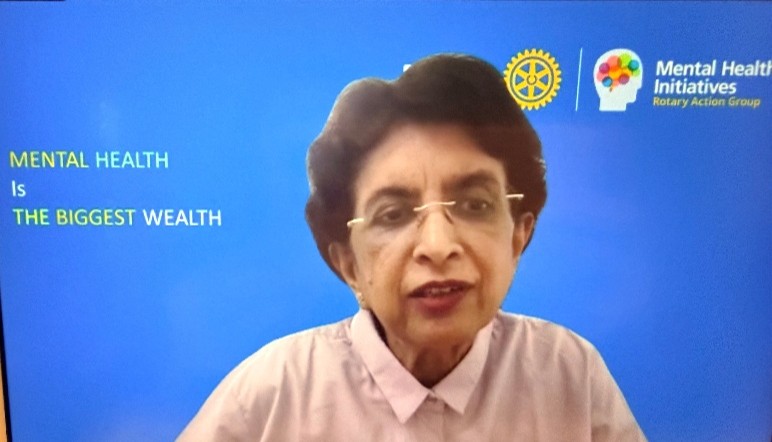
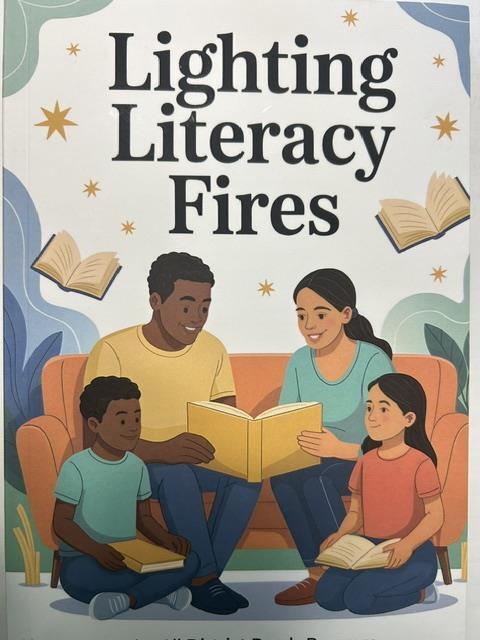
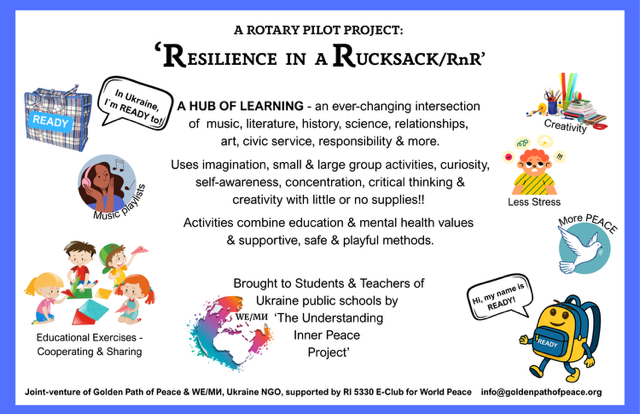
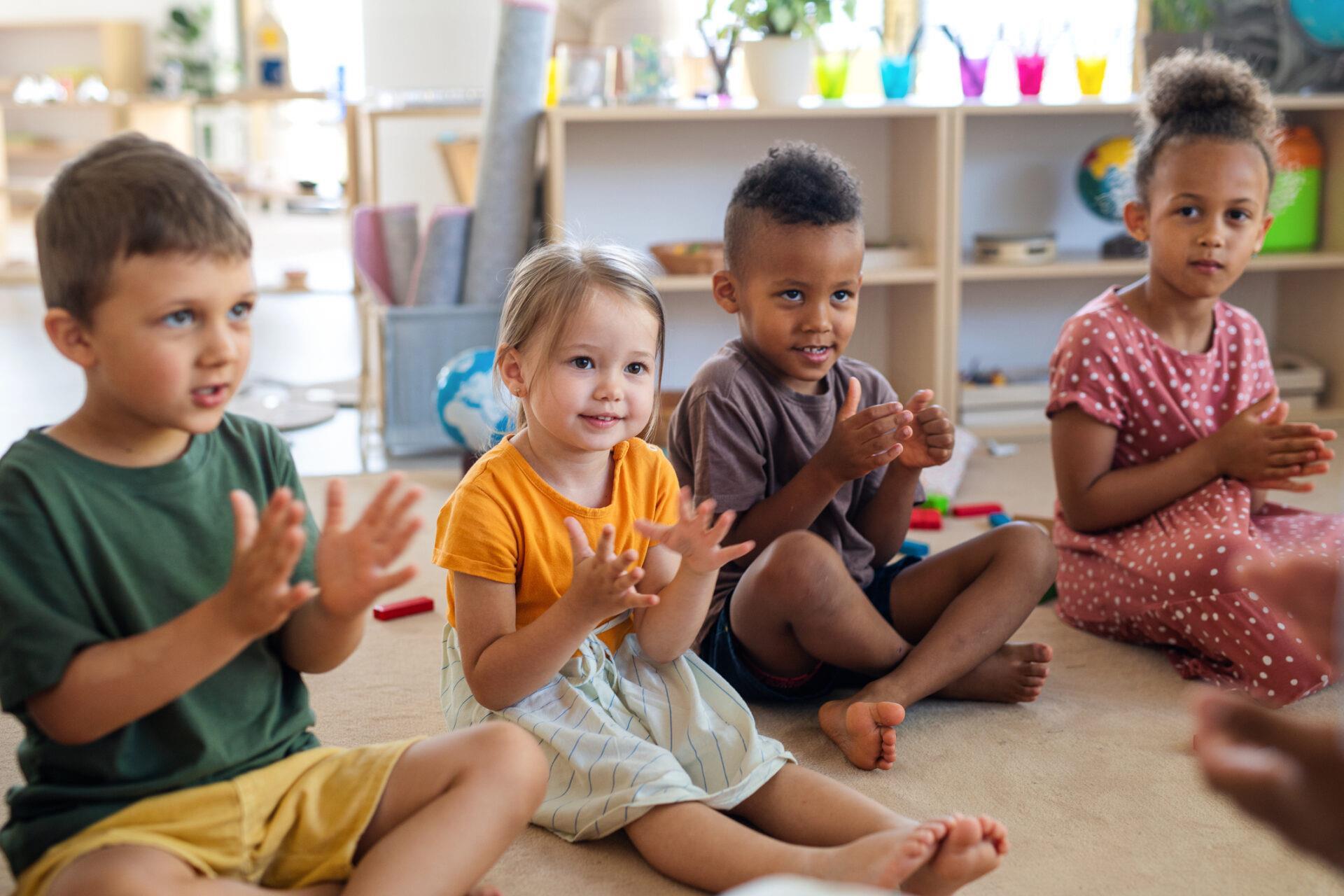
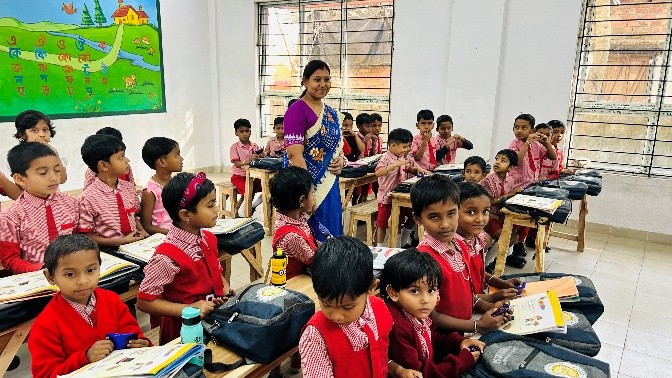
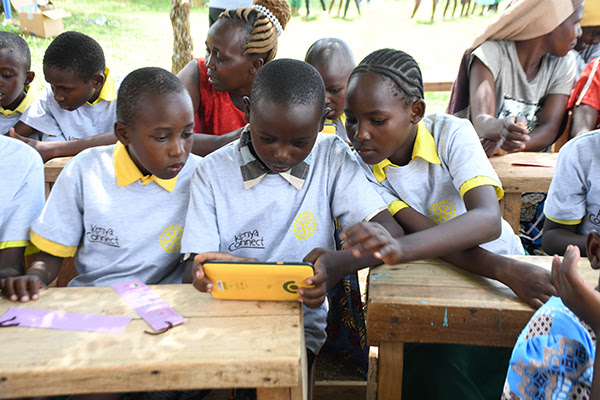
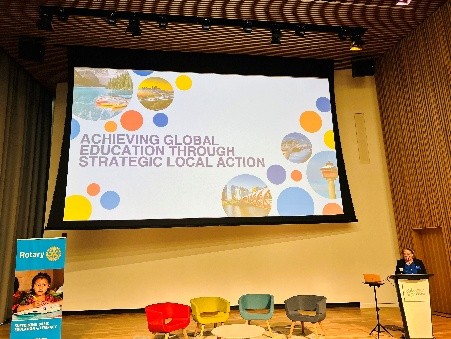
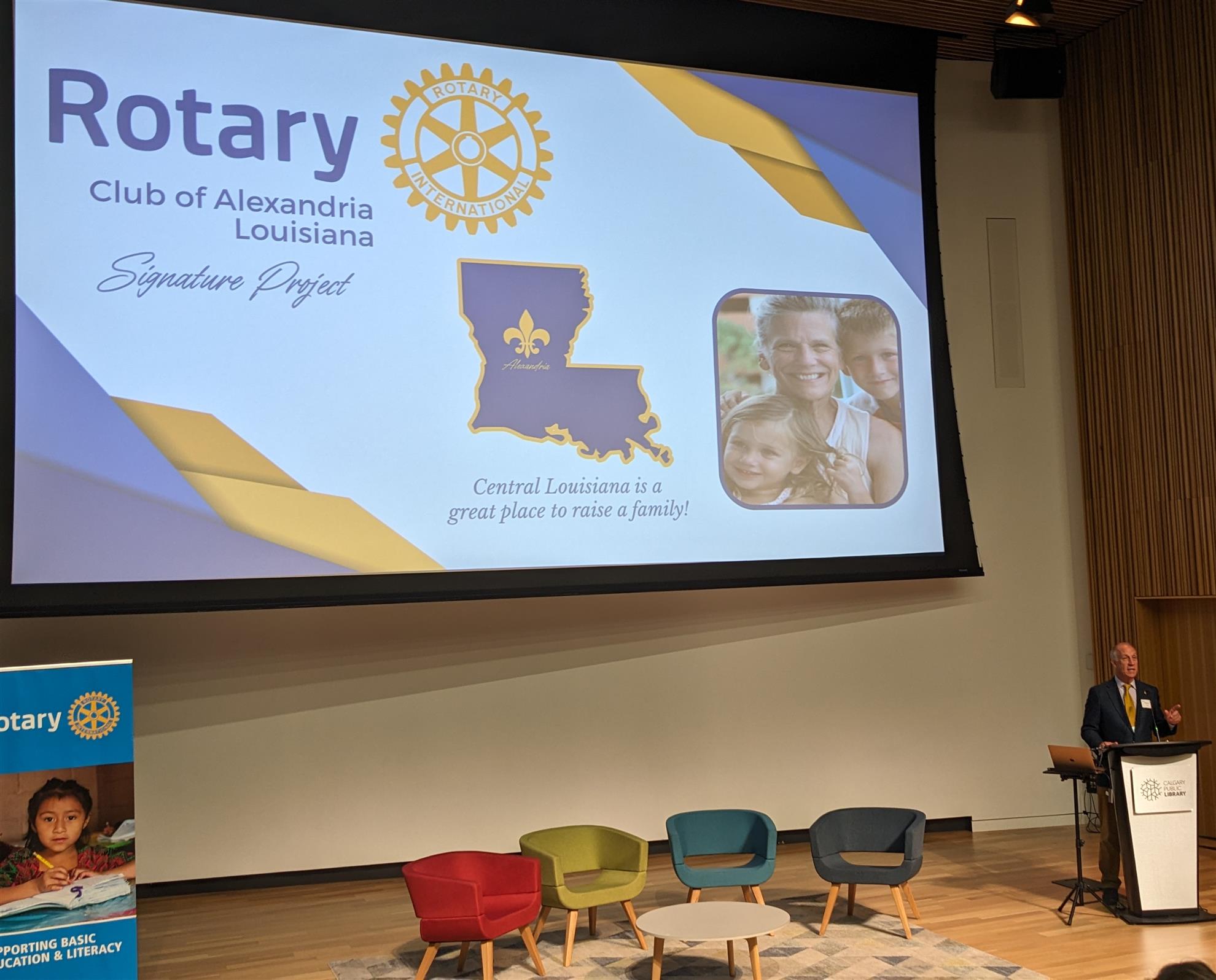
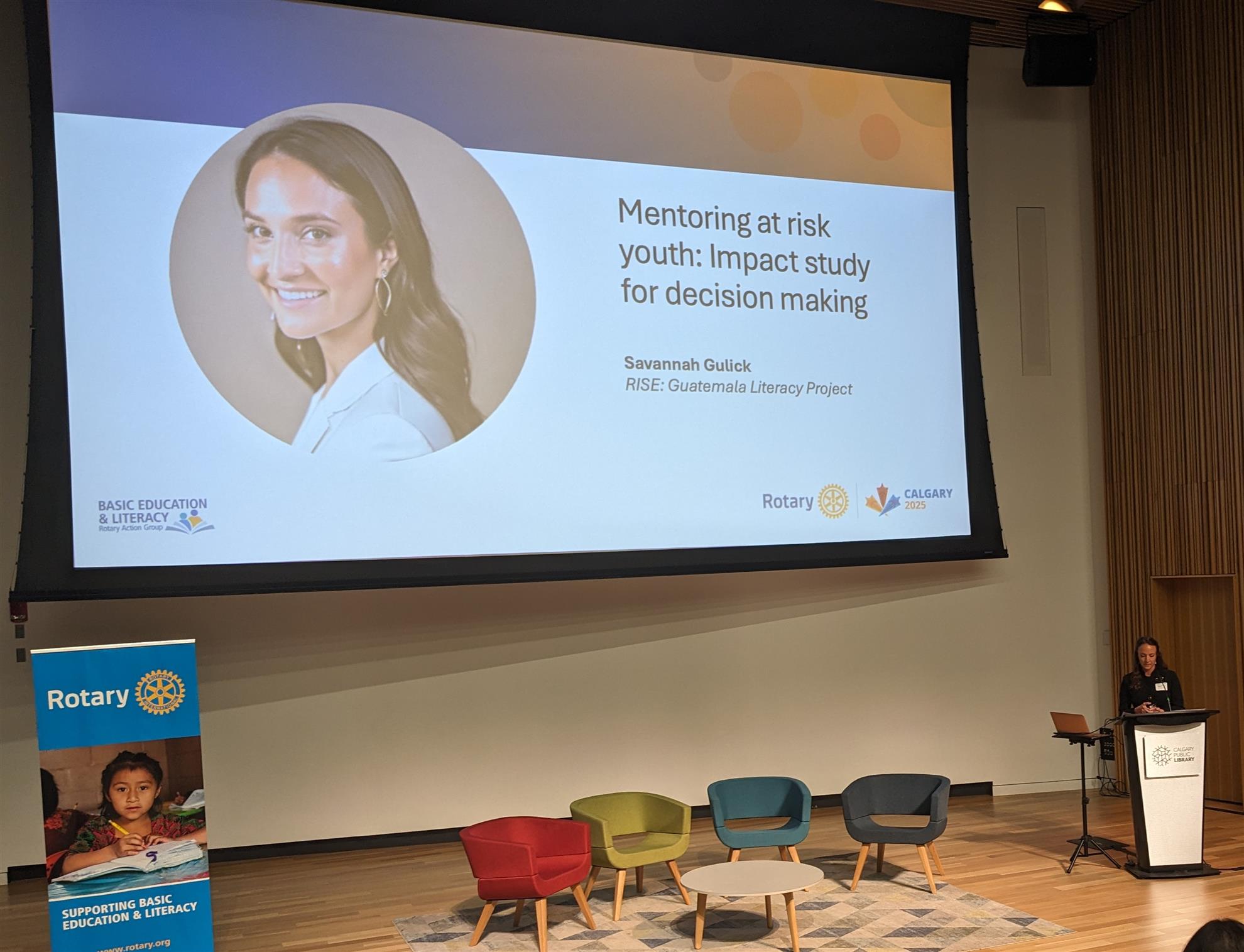
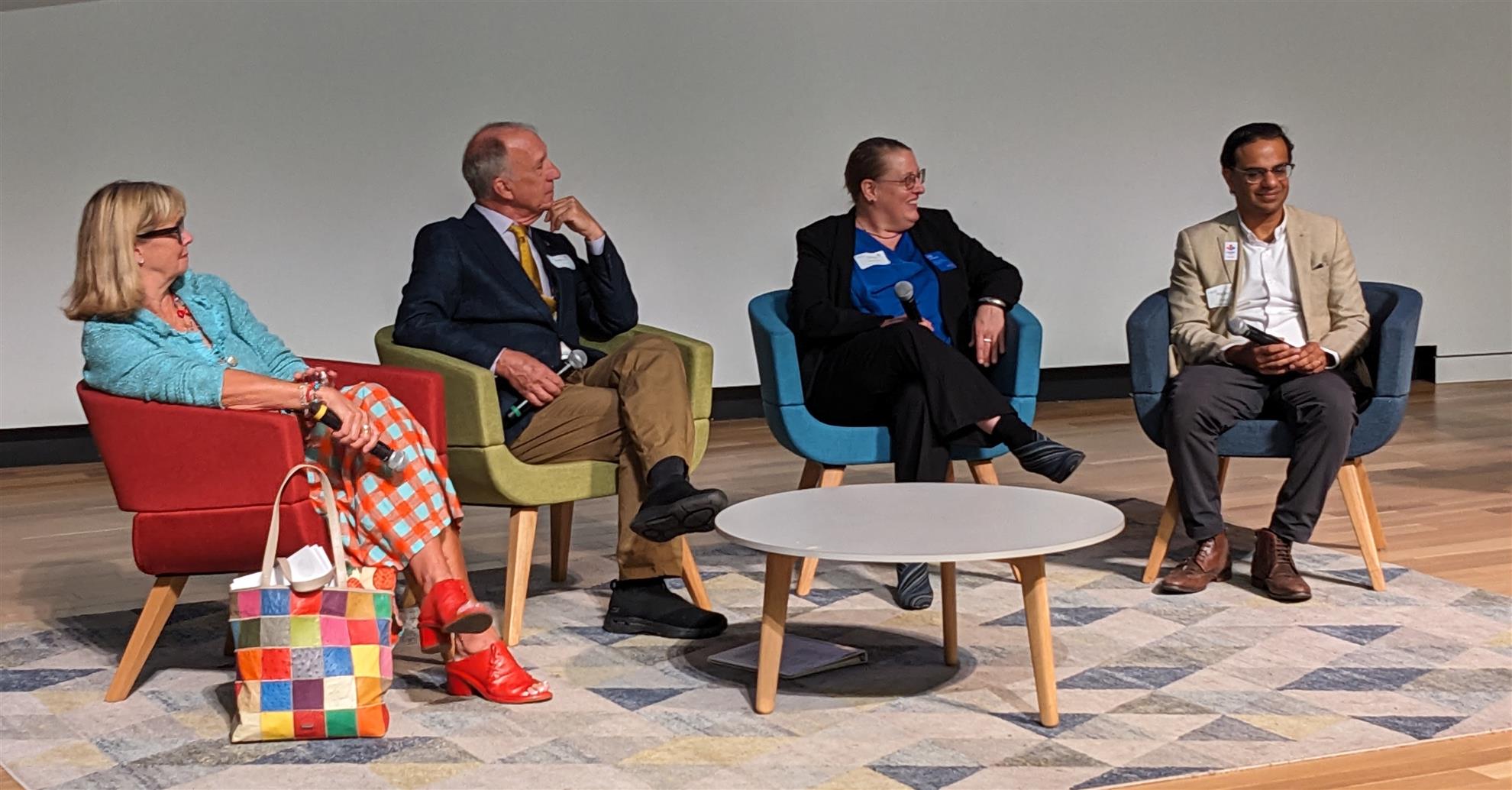

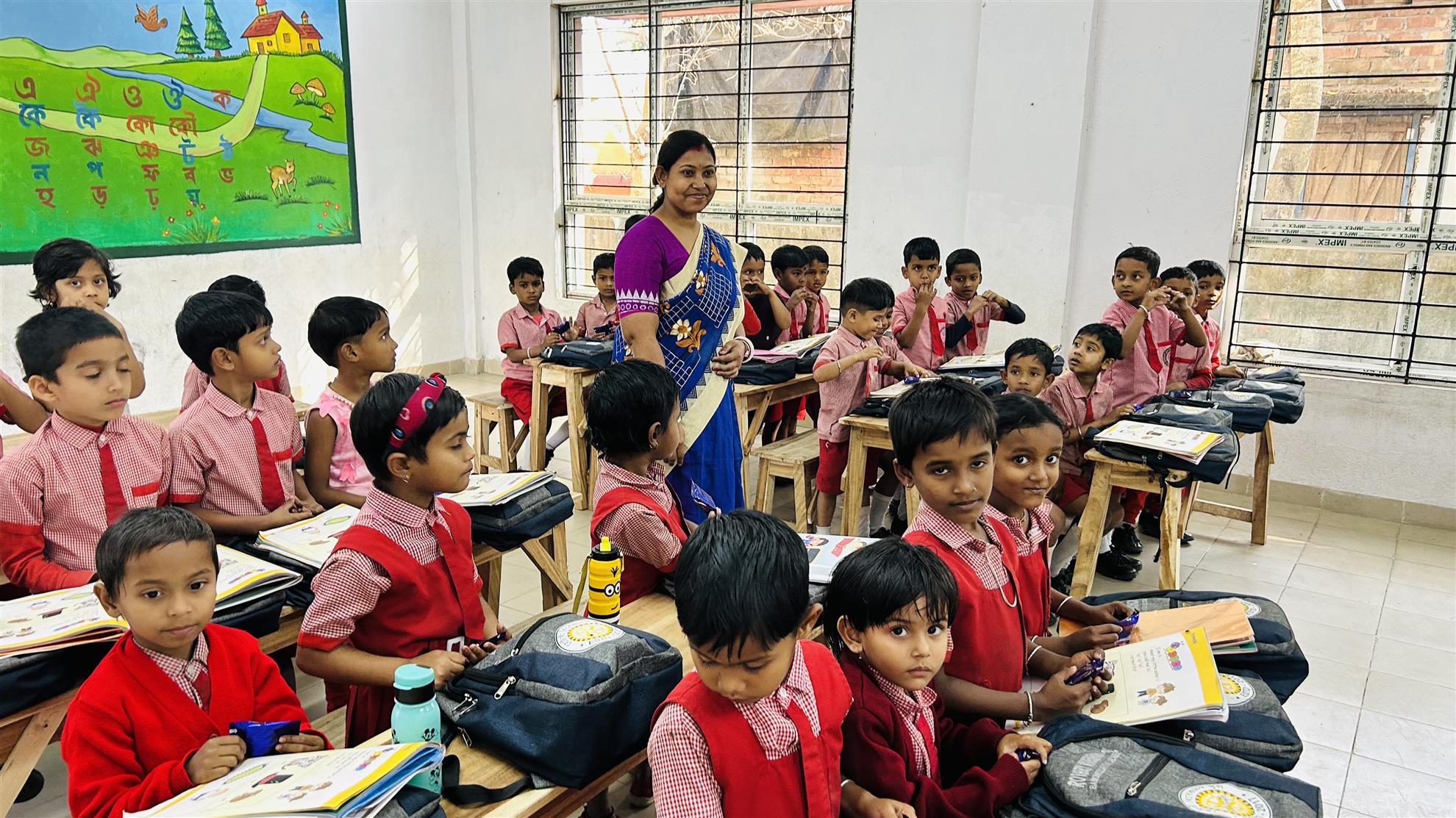

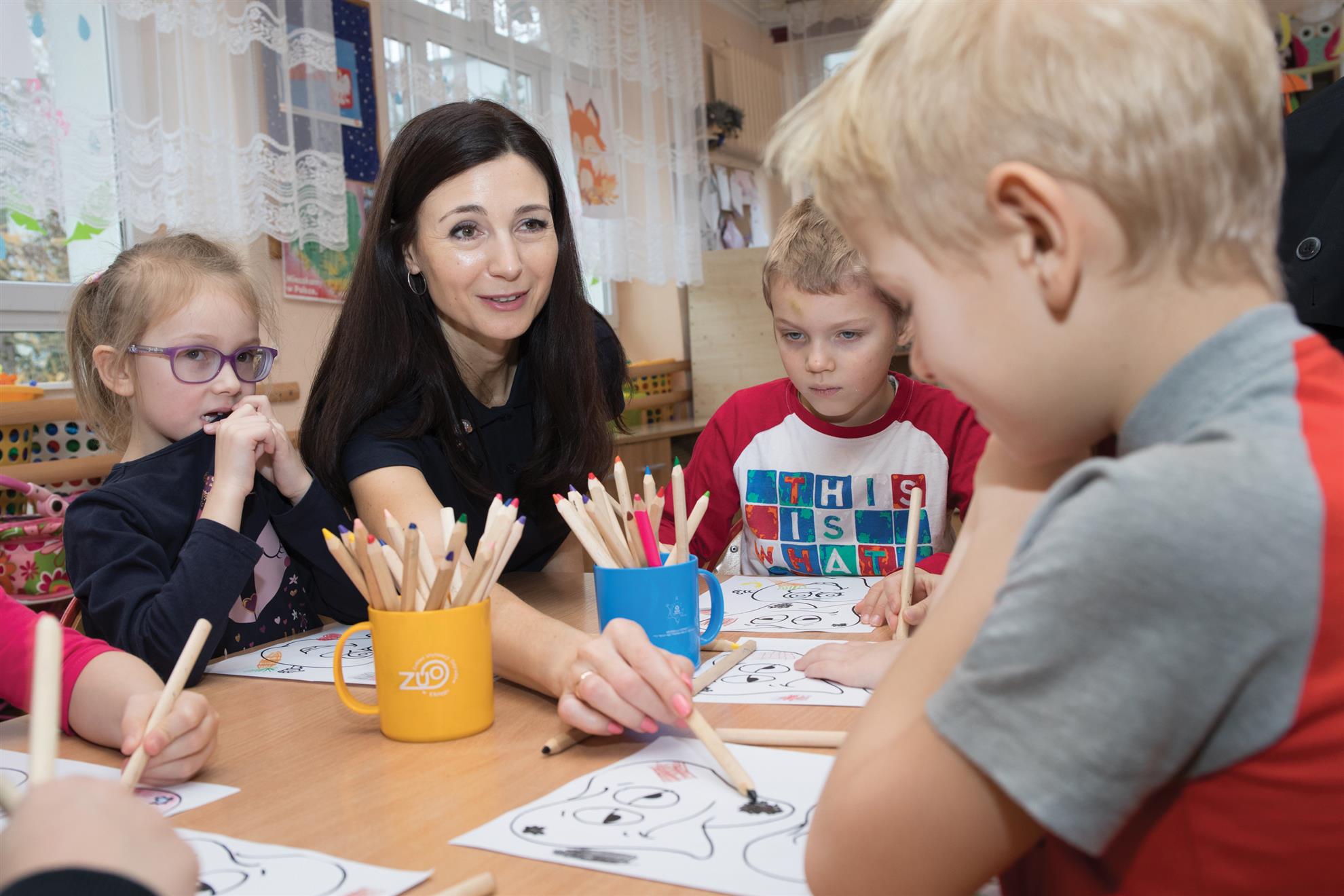
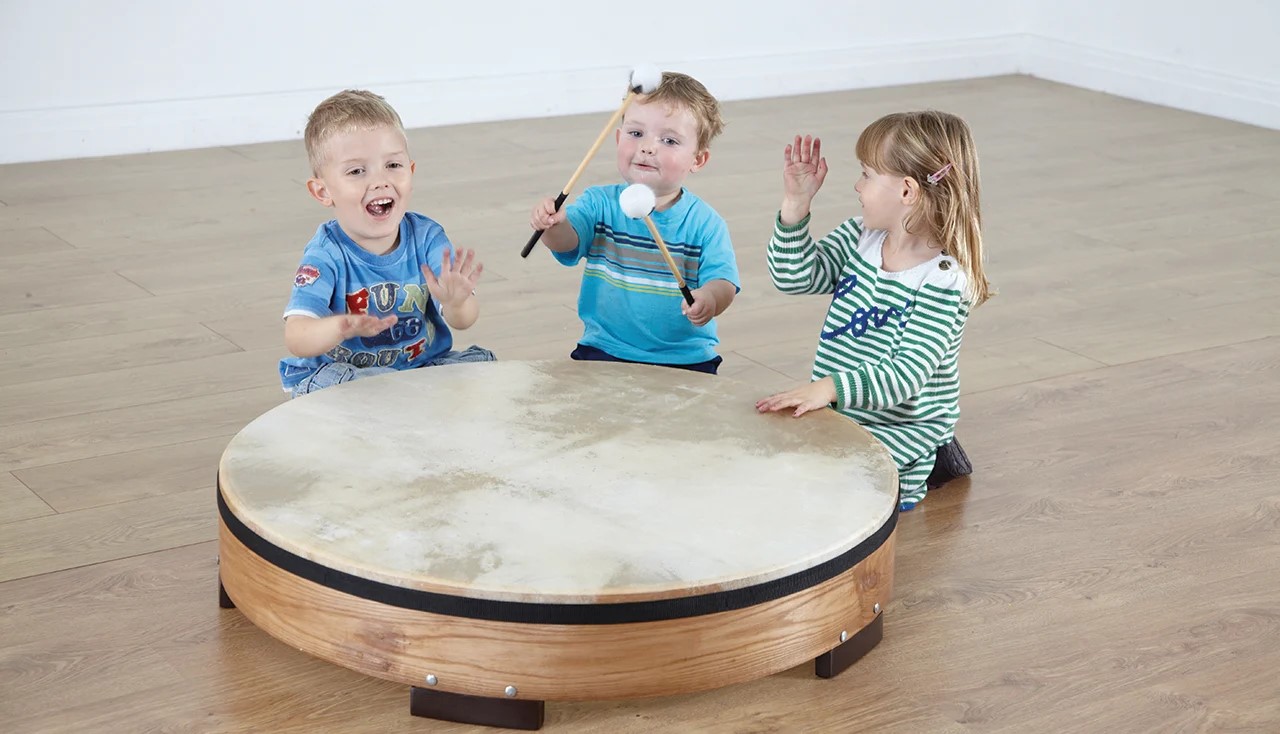


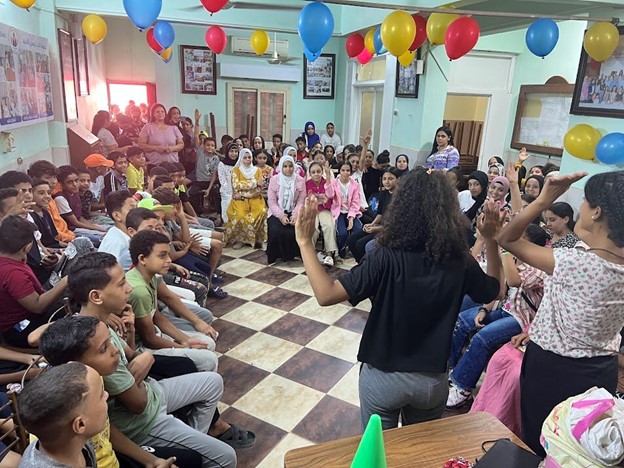
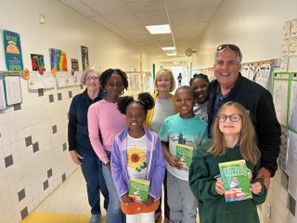 Rotary clubs have become Community Champions and have partnered with All District Reads to distribute 100,000 books in South Hampton Roads in the last 2 years! This literacy program is very simple. Once a school division decides to participate, then every elementary student receives 2 FREE children's novels to take home and enjoy night after night, chapter by chapter, with all their schoolmates. This is home-based and led by local Rotary clubs, with a Rotary sticker in each book. It occurs across all elementary schools in a school division. It ends up being a fun division-wide children's book club. “It’s exciting to reach this milestone in just two years—giving 100,000 books to start literacy fires in homes,” said All District Reads Founder and Rotarian Gary Anderson.
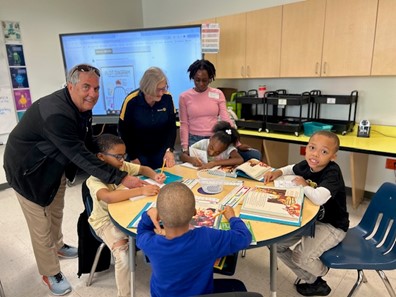 The mission of All District Reads is to partner with public school districts and communities to foster family literacy. All District Reads partners with schools, Rotary Clubs, and participating communities to encourage reading aloud in households and classrooms of all Kindergarten through 5th-grade students, with special advantages for low-income students. The ADR reading program provides a shared reading experience within homes to promote literacy and create a passion for reading.
.png)
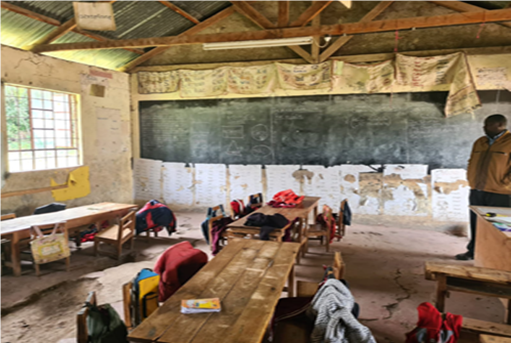
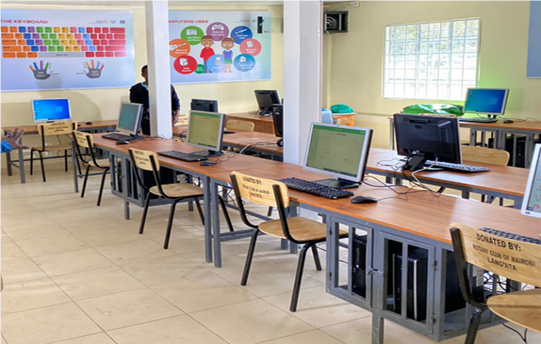


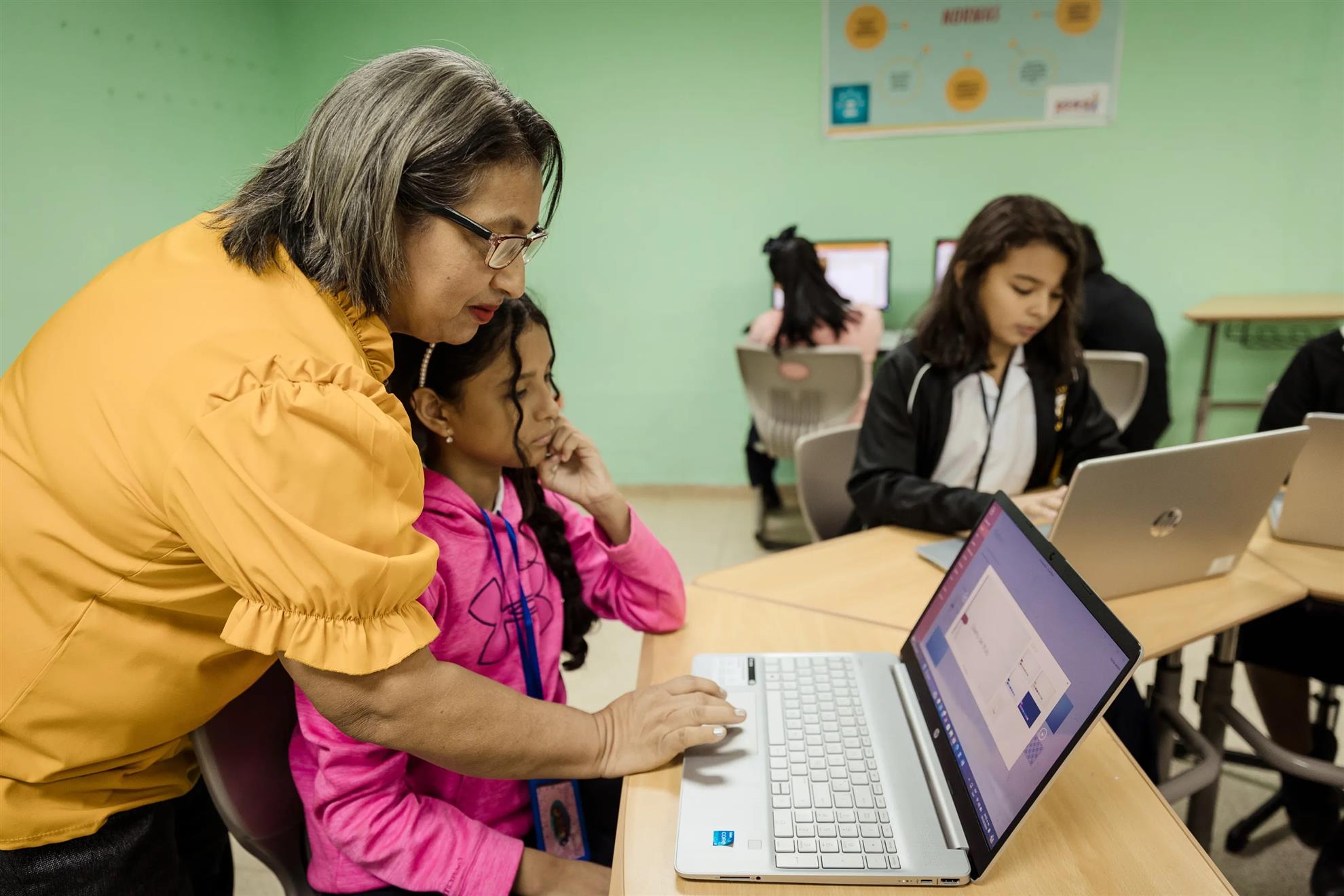

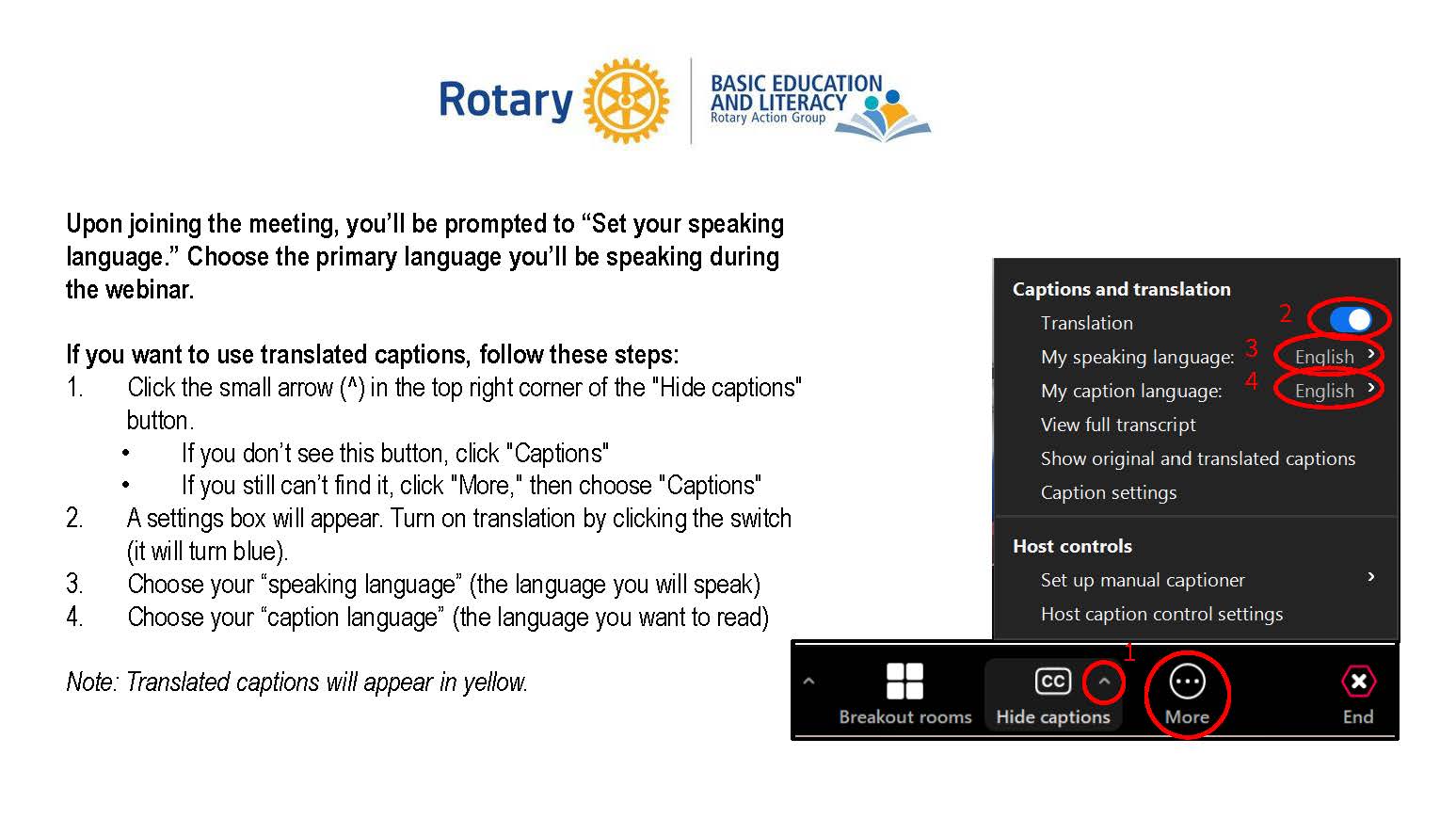

 STEM and digital literacy as pivotal tools for lucrative careers for girls. The global participation of women is much lower than men in the STEM workforce. As per

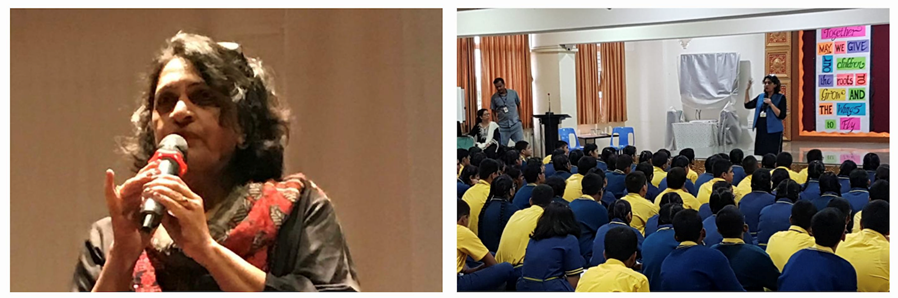
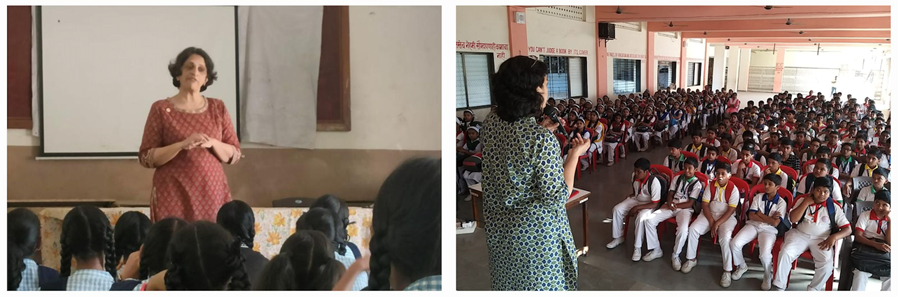
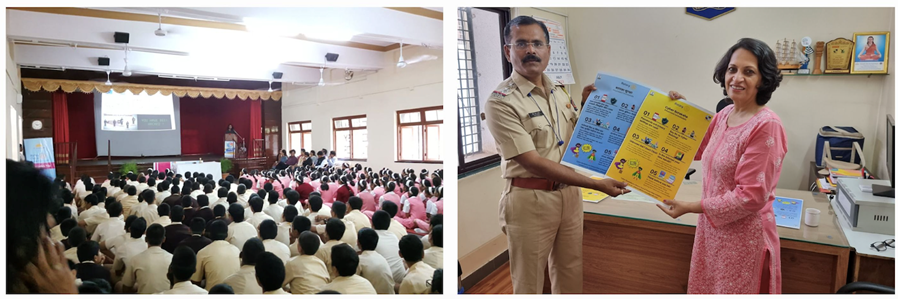
 Understanding change is an important topic for each of us. BELRAG is collaborating with ESRAG (Environmental Sustainability Rotary Action Group), Rotary International and UNESCO for Greening Education: Getting Every Learner Climate Ready. There is an opportunity for BELRAG members to participate on a steering committee that will help define and guide Rotary members to become involved in Climate Change programs for youth. We are seeking BELRAG members to get involved in work groups that will focus on: